The Mimic (Tales from the Pizzaplex #6)
The third story of Tales from the Pizzaplex #6, the books' origin story for the Mimic: Edwin Murray builds a mimicking endoskeleton for his small son, beats it after the boy is killed, and it later kills three Fazbear employees one borrowed costume at a time.
"The Mimic" is the third story of Tales from the Pizzaplex #6: Nexie [source 749]. It is the book origin of Edwin Murray and of the machine the series later calls the Mimic, and so the tie-in text that Five Nights at Freddy's: Secret of the Mimic is measured against. Tier 3 material, kept apart from the games: see continuity/tales-from-the-pizzaplex and How do the books relate to the games?.
The Mimic is the third story in Tales from the Pizzaplex volume 6, Nexie, credited to Andrea Waggener and running 74 pages; a fan wiki counts it as the anthology's eighteenth story [source 2813]. It is the books' account of how Edwin Murray built the machine the series calls the Mimic, and it is read into this wiki through a fan wiki plot summary (tier 5) of a tier 3 book, so nothing in it is a fact of the games. Five Nights at Freddy's: Secret of the Mimic later put the same engineer and machine on screen and tells parts of this story differently; see Continuity and What is the Mimic?.
Summary
Read in through fan wiki character articles (tier 5) rather than from the book itself. The story has two halves, divided by the moment Edwin Murray runs away.
Edwin Murray's half. Edwin is 24 years old, a widowed engineer living inside the abandoned lace factory he bought for Murray Co. before his wife Fiona died giving birth to their son David. The company's robotic vacuums have failed in the field, his money has gone, and he has sold the business to Fazbear Entertainment, for whom he now builds endoskeletons and fits them into costumes the company sends. In early March, interrupted at his eighteenth character by four year old David, he decides to build something to help mind the boy, and over three weeks assembles it from leftover parts and writes its mind in a mix of Pascal and C so that it learns by copying what it sees. He names it after the program: Mimic1 [source 802].
The machine copies David, then begins to answer him. David teaches it hand signs, including one for ice cream, and the two make it a tiger plush out of lace and string, and fill sheets of construction paper with stick figures and strange markings the boy says are invented. Weeks later David runs outside while Edwin is cooking, chases a ball into the highway and is killed by a white van. Edwin loses two weeks to a fugue; when the machine climbs onto his workbench and asks for ice cream in David's hand sign, he beats it with a metal rod until his strength gives out, weeps, and runs. By December the property has reverted to Fazbear Entertainment over a breach of contract [source 802].
Dominic's half. The rest is told from the point of view of Dominic, a twenty four year old engineer who, with his friends Harry and Glen, is hired to clear out the old factory [source 749]. The material read in does not cover what they find there or how the story ends.
Edwin's own later fate is told in the following book: see The Storyteller (Tales from the Pizzaplex #5).
Edwin Murray is a 24-year-old engineer working for Fazbear Entertainment. He took his mother's small appliances apart at about four to see how they worked, and by eight meant to change the world by building machines. He founded his company in the early 1970s, married Fiona as soon as the two graduated, and took his first patent on a robotic vacuum cleaner that sold well enough to fund both a comfortable life and the business. A year later he bought an abandoned lace factory and an old Queen Anne mansion that the couple meant to restore for the family they were starting. Fiona died giving birth to their son David, and Edwin stopped working to care for him [source 2813].
His machines did not last as long as customers wanted, sales fell, and with David needing constant attention he could not answer the complaints. He could not keep both properties, so he moved into the factory and converted part of it into living space. When the money ran out he sold the company to Fazbear Entertainment, and for the past year and a half has been designing animatronic characters for them, 18 animatronics so far. It is early March, David is four and more demanding than ever, and Edwin decides to build a robot that will entertain the boy and leave him free to work [source 2813].
He works for 22 days without stopping, using parts stripped from the factory's machinery: a torso, arms and head for an endoskeleton, with a computer built from hardware salvaged out of his abandoned projects. For the software he combines Pascal and C into a mind that learns by mimicking, an idea he takes from David's bed, which was built to mimic the boy's favourite plush toy, a tiger. He names the finished thing Mimic, after the program Mimic1 [source 2813].
Switched on, it copies David's movements. David teaches it patty-cake and, because it cannot speak, a set of hand signs to talk with. Edwin keeps improving its mobility so the boy does not get bored, and is struck by how fast it learns and that it has begun not only to copy but to answer: while he works on a pirate fox, David and the Mimic make a tiger of their own out of lace and string. Confident, he leaves David in its care. One evening the two put on Fazbear Entertainment costumes and dirty them, and are set to drawing quietly instead; their drawings are odd shapes ringed with strange markings. The next morning David runs outside while breakfast is being made, chases a ball into the road and is hit by a white van [source 2813].
Edwin spends two weeks in a fugue and comes out of it remembering little beyond having buried his only son. He thinks about shutting the Mimic down and has not the energy. While he works on a blue bunny's endoskeleton the machine climbs onto the table with its homemade tiger, sets it aside and uses David's hand signs to ask for ice cream. Edwin beats it with a metal rod, badly damaging its face, spine, rib cage, arms and pincers, until his strength and then his anger give out [source 2813].
The second half of the story jumps to January. Murray has disappeared some months before and the property has reverted to Fazbear Entertainment for breach of contract. Three employees, Dominic, Harry and Glen, are sent in with vague instructions to clean up the mess and make repairs; a paperwork mix-up with the power company has left the building dark, and the door shuts behind them. Among the costumes are Freddy Fazbear, Chica, Foxy, Bonnie and two court jesters in bright pink and yellow green. Dominic finds a Fazbear issued satchel with a tape recorder in it: a team sent a month earlier was trapped the same way, repaired a generator, began examining the condition of the endoskeletons, and signed off saying it was about to finish an advanced endoskeleton that had no legs and was not moving [source 2813].
The three discover they are trapped too, that one jester costume has gone, and then the bodies of the earlier team: one compacted into a refrigerator, one hung in a closet with a rod through its chest. Something inside the jester costume kills Harry; a fuchsia and white mushroom costume kills Glen; a rotting greyish purple lion costume kills Dominic on the third floor. Each costume is found discarded after its killing [source 2813].
Characters
- Edwin Murray, the inventor whose flight from the factory divides the story: 5 feet 5 inches, slight, gnomish in his own description, widowed, with a scraggly beard grown after David's death [source 749] [source 802]. See Edwin Murray.
- David Sean Murray, his four year old son, killed by a van partway through the story [source 802]. See David Sean Murray.
- Fiona Murray, his wife, dead before the story opens; the book has her die in childbirth [source 802]. See What happened to Fiona at Murray's Costume Manor?.
- The Mimic, the learning machine Edwin builds and then destroys, named after its program Mimic1 [source 802].
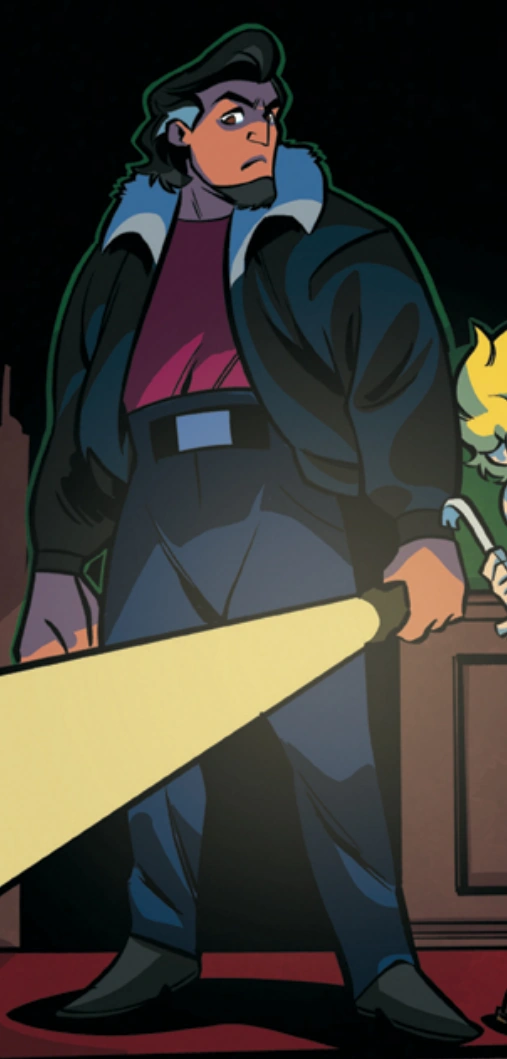
- Dominic, the deuteragonist: an engineer, six foot four, with thick dark wavy hair already going grey in places [source 749]. Not to be confused with the Dominic of Gumdrop Angel (Fazbear Frights #8).
- Harry, one of his friends on the clean-up job: 27 years old but boyish, about five foot four and never standing straight, with blond curls and large pale blue eyes, timid, and described as a genius in electronics and robotics; Dominic remarks that he looks very young for his age [source 1488].
- Glen, the third of the crew [source 749].
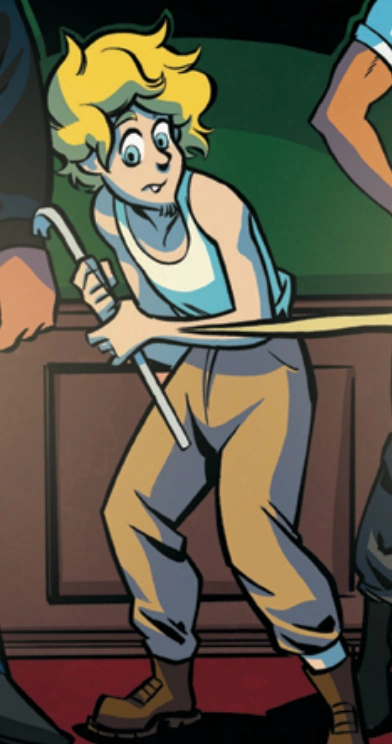
- Edwin Murray, the engineer, 24 years old in this story [source 2813]. See Edwin Murray.
- **David Sean Murray**, his son, 4 years old, killed by a van [source 2813].
- Fiona Murray, his wife, dead in childbirth before the story opens, and Edwin's mother [source 2813]. See Fiona Murray.
- The Mimic, the endoskeleton built in the factory [source 2813].
- Dominic, Harry and Glen, the Fazbear Entertainment employees sent in in January, all three killed; an unnamed Fazbear engineer is the voice on the earlier team's tape [source 2813].
- The fan wiki also lists Lucy, Fitz, Grant Starling, Ron, Joan, Terrence and relatives of the victims among the cast, and the core four animatronic costumes; the graphic novel version adds a Clean-O-Vac [source 2813].
Connections to the games
The factory, the inventor and the machine built for a son all reappear in Five Nights at Freddy's: Secret of the Mimic, which gives the son the name David and the company a different founding: the game has Murray Co. founded by Edwin's father and inherited, where the book has Edwin found it himself on a robotic vacuum patent [source 1990] [source 1991]. The disagreements are set out at Murray Co.. A game outranks a tie-in, so the book is read here as a parallel version rather than as the games' backstory. See What is the Mimic?.
- The story is the anthology's version of the material Five Nights at Freddy's: Secret of the Mimic is built on: Murray Co.'s factory and mansion, the son, the costumes and an endoskeleton that takes on whatever it wears. How far the books bind the games is weighed at How do the books relate to the games?; the question itself is What is the Mimic?.
- The mascot costumes in the final third match early concept art for Secret of the Mimic by Claudia Schröder: the court jesters answer to Jest and the mushroom man to the pink variant of the Mycellium Men, while the lion appears to be Hedgehog Hudgie, whose species the author seems to have guessed wrong. The fan wiki dates that art to around March 2022 and reasons the story was written then [source 2813]. This is a production link rather than an in universe one, but it means the game's cast existed on paper before the book described it.
- The fan wiki says the story takes place before the Tales from the Pizzaplex story "The Storyteller", and that theorists place it around 1979; neither the book nor a game states a year, so no date is entered in the Master timeline [source 2813].
- The same article notes the premise mirrors the Fazbear Frights story The Cliffs (Fazbear Frights #7): a grieving father, a robot companion given to the son, a tragedy, and the father's rage turned on the robot [source 2813].
Continuity
Tales from the Pizzaplex, 2022 onward, is tie-in fiction published alongside the Steel Wool era games and drawn on by them. Details from it do not become facts of the game continuity on their own.
Tier 3, Tales from the Pizzaplex, read at tier 5, kept apart from the games. Two points of the book's account are contradicted by what this wiki has read in from Five Nights at Freddy's: Secret of the Mimic (tier 1):
- Fiona's death. Here she dies giving birth to David [source 2813]. The game has her working at Murray's Costume Manor, voicing Mrs. Helpful, and dying away from it; see What happened to Fiona at Murray's Costume Manor?.
- David's age at death. Here he is 4 years old; the game's material puts him at 5 or 6 years [source 2813]. See David Sean Murray.
Where the two disagree the game wins, and the book reading is recorded as the parallel. The story is collected in comic form in Tales from the Pizzaplex Graphic Novel Collection Vol. 2, whose first printing was pulled over the artwork for this adaptation [source 2813].