Animatronics and bots
How the series' robots sort out: entertainment animatronics, electronic toys, S.T.A.F.F. Bots, automated voices and the novels' androids, with who is said to have built which, and an index of the group pages.
The machines the series is built around, and the way the community sorts them. The classification below is the fan wiki's scheme (tier 5) rather than one any game states, but the manufacturer attributions in it come from what the games show [source 185]. The frames inside the suits have their own page at Endoskeletons.
Types
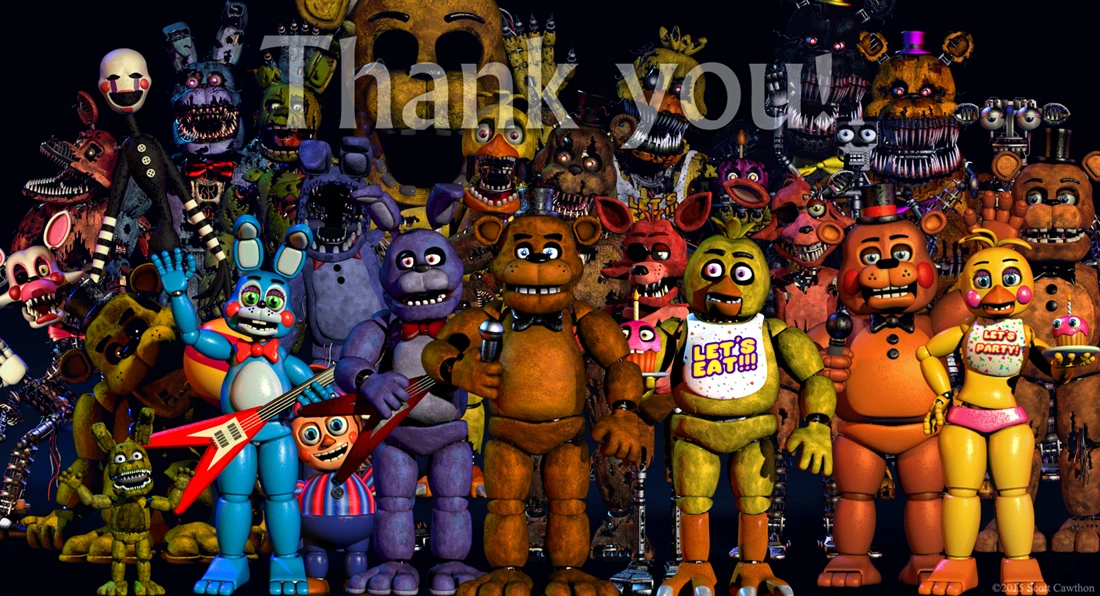
- Animatronics. The recurring kind: machines built to look lifelike, with movable limbs, voice boxes and a fabric or plastic suit over an endoskeleton, used for entertainment in restaurants, and in some cases built as toys [source 185]. Not all are full bipedal figures: the Primary Control Module of Five Nights at Freddy's: Sister Location holds 3 heads animatronic human heads, which the fan wiki guesses were for testing facial expressions [source 185]. See The control module animatronics.
- Electronic toys. Smaller animatronics made as toys or in-universe merchandise, among them the novels' Theodore, Stanley and Ella and the Fazbear Frights line of defective playthings [source 185]. See Plushtrap Chaser, Lucky Boy, Tag-Along Freddy and Buddytronic Dolls.
- S.T.A.F.F. Bots. Robots that hold jobs rather than perform: servers, waiters, security, cleaning. The fan wiki dates their introduction to Five Nights at Freddy's: Security Breach, where they work at Freddy Fazbear's Mega Pizzaplex [source 185]. See Security Bots, Map Bots and Nightmarionne S.T.A.F.F. Bots.
- Artificial intelligence. Voices without bodies, used to instruct employees, HandUnit being the usual example [source 185]. See HandUnit, Tutorial Unit, Dread Unit, Stage Manager and F10-N4 (M1).
- Androids. Robots built to pass as people. The fan wiki marks this category as belonging to the novel trilogy alone: there, Henry Emily built four robots after his daughter's death, each representing a stage of her life, powered by a rag doll housing his emotional energy, with Charlie as the teenage version and Ella as the toddler, and Baby meant to be the adult [source 185]. The same passage adds that the rag doll does not apply to Baby "since she was later possessed by Elizabeth Afton", which mixes continuities: Elizabeth's death at Circus Baby's hands belongs to the games (see Elizabeth Afton), not to the novels' account of Henry's robots. Treat the android scheme as novel trilogy material only and keep it apart from the game story [source 185].
Who builds them
The fan wiki's summary of in-game attribution: most animatronics are products of Fazbear Entertainment, Inc., while the Five Nights at Freddy's: Sister Location cast and the Funtime and Twisted lines are credited to Afton Robotics, LLC; the rental arm in Five Nights at Freddy's AR: Special Delivery is Fazbear Funtime Service [source 185]. In the novel trilogy the original four were made by Henry Emily instead [source 185], which no game read into this wiki says. Five Nights at Freddy's: Secret of the Mimic puts a third builder behind the earliest designs, Murray Co.; the question is open at Who built the classic animatronics, and were there always four?.
Groups with pages
- The Funtime animatronics, The Glamrock animatronics, Halloween animatronics, Scrapped and cut animatronics, Endoskeletons.
- Vendor bots, Clean-O-Vac, Candy Cadet.
- Wanted, and all listed as groups by the fan wiki: topic/withered-animatronics, topic/toy-animatronics, topic/nightmare-animatronics, topic/phantom-animatronics, topic/rockstar-animatronics, topic/mediocre-melodies, topic/staff-bots, topic/cupcake-animatronics, topic/waterpark-animatronics, topic/twisted-animatronics, topic/animatronic-skins [source 185]. Of these, What are the shadow animatronics? already holds the shadow set.
- Fanverse lines are kept at Fan games and the Fazbear Fanverse and The Joy of Creation [source 185].
How far they are machines
The fan wiki also collects the ways the series' animatronics differ from real ones: real units are driven by mechanics installed in the floor, so a stage animatronic could not walk away without dismantling itself; commercial restaurant animatronics are given no articulation below the hips for stability, where these have knees, thighs and ankles; and servomotors would jam or loosen from overuse rather than lock up from standing still, as the first game's phone calls claim [source 185]. These are community observations (tier 5) about engineering, not evidence about the story, but they are worth keeping in view: within the games, every one of these impossibilities is a sign that something other than programming is moving the suits. See What is Remnant?.