What is real in Five Nights at Freddy's 4?
The minigames are real events (the week before the 1983 bite, the bite, the hospital) and the bedroom nights are nightmares, not machines in a house, but Sister Location makes the room itself real and under observation ("Obsv. 2", the 1-9-8-3 camera feed); the player is most likely the bitten child, with Michael Afton the tier 3 alternative.
Current answer, worked out
The eight-bit minigames are the real events (the week before the 1983 Fredbear bite, the bite, and the hospital), while the bedroom nights are not literal: the nightmare animatronics are a terrified child's nightmare images, never shown anywhere in the world outside a dream, VR or custom-night frame. The room itself, however, is real and was watched: Sister Location labels it "Obsv. 2" and shows the bedroom, bed and hallway on camera to the code 1-9-8-3. The player is most likely the bitten child himself, with Michael Afton the main alternative, resting on the tier 3 Survival Logbook.
How sure the solver is, from the evidence below. It is worked out again when new evidence arrives. Every mystery.
Are the nightmare animatronics real, hallucinations or dreams, and who is the player in the bedroom?
Answer
The minigames are events; the nights are not; the room is real and was being watched. Moderate confidence (about 58 per cent), and lower still on who holds the flashlight.
Five Nights at Freddy's 4 runs two layers, and they are not of the same kind.
The eight-bit end-of-night minigames are presented as things that happen: a countdown from "5 days until the party" to "0 days", a boy tormented by his older brother and left at Fredbear's Family Diner, the party at which four boys push his head into Fredbear's jaws, and a last scene over a sound like a heart monitor flatlining [source 648] [source 1911] [source 1930]. Every later game that touches this material treats the bite as an event, not as a dream; see The Bite of '83 and the Bite of '87 and Who is the crying child?.
The playable nights are the other layer. Nothing in any game shows a nightmare animatronic existing in the world: their only later appearances are the Night Terrors levels of Five Nights at Freddy's: Help Wanted, which the game itself frames as a digital recreation of the House inside a virtual experience, and Ultimate Custom Night, which is a roster with no place in the chronology [source 2796] [source 296]. The roster is not even stable: Scott Cawthon said the Halloween Edition nightmares are non-canon apart from Nightmare Balloon Boy, which is hard to say of physical machines but easy to say of images in a nightmare [source 2103]. The cast is made of the diner's own characters warped into monsters, matching the Freddy, Bonnie, Chica and Foxy masks the brother and his friends wear [source 2103] [source 1911], and Nightmare Fredbear later repeats the Fredbear plush's promise to put the player back together [source 2384].
What the nights are not is free-floating. Three bedside objects, appearing at a 3 in 100 chance, put a vase of flowers, a pill bottle and an intravenous drip in the room the player defends [source 790], and the minigames end with the child in hospital [source 1930]. And Five Nights at Freddy's: Sister Location (2016) revised the setting outright: the Breaker Control Box lists eight breakers, two of them areas of the fourth game labelled "Obsv.1" and "Obsv.2", with the bedroom house drawn attached to the Private Room; entering 1-9-8-3 on the Private Room keypad puts the Bedroom, the Bed and the Hallway on the monitors, seen from an upward angle, beside a Fredbear plush with what looks like a walkie-talkie [source 384] [source 568] [source 2369]. That is a game saying the bedroom was wired for observation and that someone was watching, which kills the pure "it was all a dream in an ordinary house" reading as much as it kills the "the monsters were walking the hallway" one.
The reading that survives all of it with the fewest additions: the fourth game is a real child's nights in a room that a Fazbear facility had under camera, and what he suffers in them is terror rather than machinery. Whether the fear was simply his own or was being induced and measured is the live question, and the only account of induced fear in that room is tier 3: Dittophobia (Tales from the Pizzaplex #8) makes a recreation of the bedroom a testing chamber where a kidnapped boy is dosed with hallucinogenic gas and the nightmares turn out to be mounted suit parts on rolling stands [source 743] [source 2110] [source 568]. Books are a parallel line, not a fact of the games: see How do the books relate to the games?.
On the player: the game never says. The structure points at the bitten child, since the nights are interleaved with his week, the hospital objects and the flatline belong to him, and Nightmare Fredbear arrives on the night whose minigame is the party. The competing candidate is Michael Afton, on the strength of the tier 3 Survival Logbook, where its owner answers a question about recent dreams by drawing Nightmare Fredbear [source 2796] [source 2103]. That is a book, and the same logbook is widely read as haunted by the younger brother, so it cannot carry the question on its own; see Who is Mike Schmidt?.
MatPat's Dream Theory in its strong form, that the first four games are the comatose child's dream, is rejected: the later games proceed as events in the world, and Scott mocked the theory himself in a 2018 April Fools entry in the Ultimate Custom Night character guide, giving Nightmare Freddy an alarm clock that wakes the player in bed [source 194] [source 767]. See Dream Theory.
Evidence for
The two layers, and which one the game treats as real. The end-of-night minigames carry a countdown, a cast of named behaviours and a consequence: the brother in the Foxy mask, the diner, the party, the jaws closing, and a final scene in which the plushies fade over a flatline sound [source 648] [source 1911]. A fan wiki catalogue of the series' minor locations records plainly that the child is taken to a hospital after the bite [source 1930]. The playable nights carry none of that: no date, no aftermath, no other person.
The objects beside the bed. A fan wiki catalogue of the game's easter eggs (tier 5 reporting the game, tier 1) says that each time the bedroom view comes up there is a 3 in 100 chance of one of three objects appearing on the table beside the bed: a vase of flowers, a pill bottle or an IV drip. They can follow the light flicker when Nightmare Fredbear, Nightmare or Nightmarionne leave the bed, but never follow the Freddles [source 790]. An intravenous drip in a child's bedroom is the game placing hospital equipment in the space the player defends, and it is the main in-game support for readings in which the nights are a dying or sedated child's experience rather than a house at night.
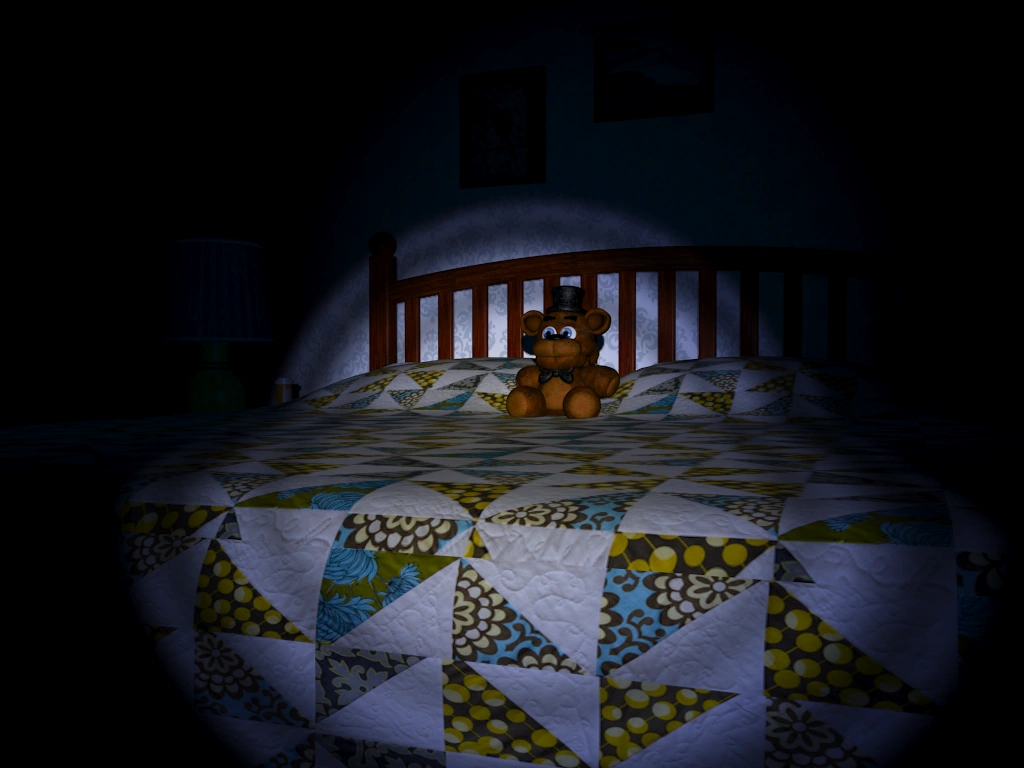
The nightmares never appear in the world. Every later appearance of the nightmare animatronics sits inside a frame that is explicitly not reality: the Night Terrors levels of Five Nights at Freddy's: Help Wanted are a digital recreation of the House within the Freddy Fazbear Virtual Experience, the Curse of Dreadbear add-on reuses the hallway as a minigame, and Ultimate Custom Night is an unplaced roster [source 2796] [source 296] [source 290]. No game read in here shows one in a pizzeria, a street or a house outside that frame.
The roster is not stable, and Scott said part of it is not canon. A fan wiki article on the nightmare animatronics reports Scott Cawthon saying the Halloween Edition nightmares are non-canon except Nightmare Balloon Boy, and notes the reading that he meant they never existed in the lore and were there for the season [source 2103]. Nightmarionne replaces Nightmare and Nightmare Mangle replaces Nightmare Foxy without any change of role [source 287] [source 2143]: substitutable images, not individuals. See Nightmarionne and Nightmare Mangle.
The cast matches the child's fears. The same article records the reading that Nightmare Freddy, Bonnie, Chica and Foxy stand for the older brother and his friends tormenting the child, who wear exactly those four character masks in the minigames [source 2103] [source 1911]. It also records the reading that Nightmare personifies the death itself, from a jumpscare sound heard as an ambulance siren or a heart monitor [source 2103]; the jumpscare is also the only one in the game that is a still image, is unusually quiet, skips the blood splatter and is withheld from the Extras viewer [source 1652].
The plush's promise comes back in a nightmare's mouth. In the sixth minigame the Fredbear plush tells the broken child it will put him back together [source 1911]; in Ultimate Custom Night Nightmare Fredbear says he will put the player back together and then take him apart all over again [source 2384]. The line ties the figure in the bedroom to the child of the minigames rather than to a separate victim.
**Links from Five Nights at Freddy's: Sister Location to the House (read in 2026-11-17).** A fan wiki article on the House (tier 5 describing what the games show) records two of them [source 2796]. The Breaker Control Box map in Sister Location labels a space attached to Circus Baby's Entertainment and Rental "Obsv. 2" and gives it a layout resembling the bedroom and halls of Five Nights at Freddy's 4. Entering 1-9-8-3 on the keypad in the Private Room makes the three monitors show the bedroom, the bed and a hallway. Both point to the bedroom scenes being tied to a Fazbear facility rather than to an ordinary family home, and the keypad code is the year the series elsewhere attaches to the bite; see The Bite of '83 and the Bite of '87.
The breakers themselves carry the labels. A fan wiki article on the Breaker Control Box interface (tier 5 reporting tier 1) sets out that the panel resets eight breakers: Circus Control, Circus Gallery, Funtime Auditorium, Ballora Gallery, Parts and Service, the Elevator, and two areas from the fourth game labelled "Obsv.1" and "Obsv.2" [source 384]. That is the facility's own power grid treating the fourth game's spaces as its rooms. The same article adds that the 1-9-8-3 monitors suggest the events of the fourth game were being monitored by someone, and may go as far as implying that parts of the fourth game were reality rather than a dream, while noting that whether the nightmare animatronics and Plushtrap exist is debated [source 384]. The Bed's own history page records that the camera views are from an upward angle, as a mounted camera would be [source 290].
The Fredbear plush beside the monitors. The Private Room easter egg places a Fredbear plush, apparently identical to the one that speaks to the child, next to the monitors and beside what looks like a walkie-talkie or remote control [source 384] [source 2103]. The fan wiki's own reading is that someone spoke to the child through the plush and watched him on camera [source 2384]. That would make the plush's voice a person rather than a dream, which cuts against a wholly interior reading of the nights; see William Afton.
The playable house is not the house of the minigames. The minigame home has a bedroom, a corridor with a grandfather clock, a second bedroom, a living room and a fenced garden onto the street [source 1930]; the playable space is a bedroom with a closet between two long hallways, with an unseen area and a kitchen at the far right of the map [source 2988] [source 2796]. A fan wiki notes that the Obsv. 2 diagram bears an uncanny resemblance to that playable layout, bedroom, closet, both halls and kitchen [source 2369].
**The Breaker Room map in Five Nights at Freddy's: Sister Location (tier 1 through tier 5).** A fan wiki article on Circus Baby's Entertainment and Rental reports that the map shown on the Breaker Room panel places rooms from Five Nights at Freddy's 4 around the Funtime facility: the Private Room adjoins the house where the fourth game is played, labelled Obsv. 2; the Ballora Gallery adjoins the Fun with Plushtrap hallway, left unlabelled; and the Circus Gallery auditorium adjoins Fredbear's Family Diner, labelled Obsv. 1 [source 568] [source 385]. If "Obsv." is observation, the game is presenting the fourth game's bedroom and the diner as rooms being watched from the facility rather than as an ordinary house and restaurant.
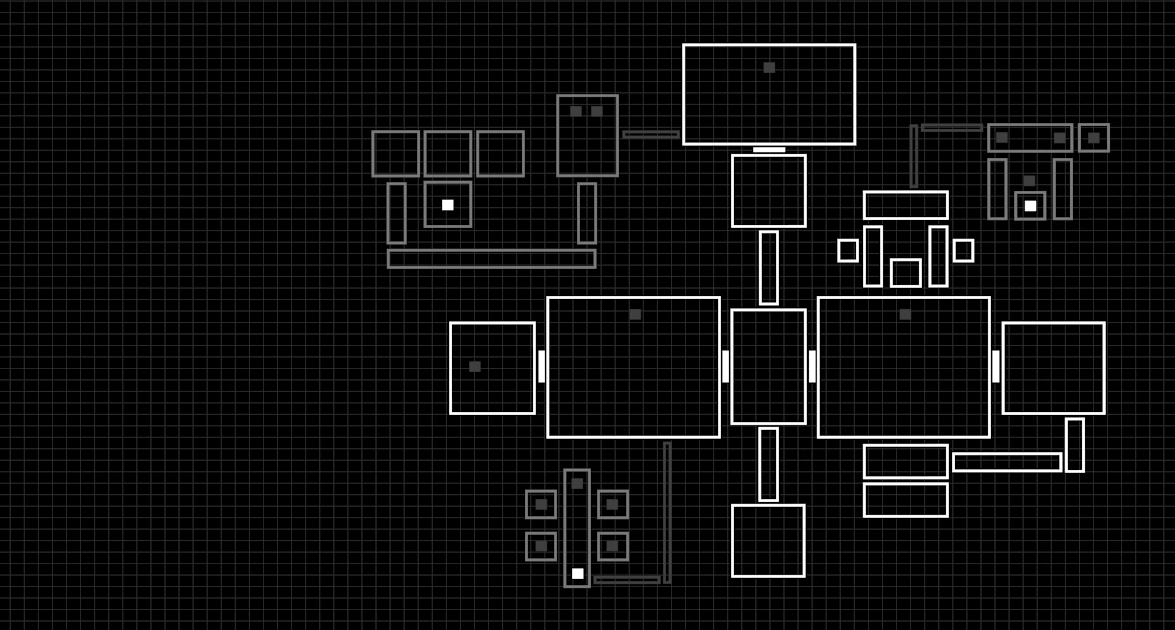
The same article adds that the Tales from the Pizzaplex story Dittophobia (Tales from the Pizzaplex #8) (tier 3) states the Five Nights at Freddy's 4 bedroom, or a recreation of it, was indeed connected to the facility and was a testing chamber in which kidnapped children were experimented on [source 568]. The story's own mechanism is that the boy Rory breathes a hallucinogenic gas, and that once the gas stops the nightmares are revealed as mounted suit parts on rolling mechanical stands [source 743] [source 2110]. A tie-in cannot settle a game's meaning on its own, and the books are kept as a separate continuity unless a game or Scott Cawthon joins them; see How do the books relate to the games?. The map labels, however, are the game's own text.
A parallel detail from a later game: David Murray's bedroom in Five Nights at Freddy's: Secret of the Mimic resembles the Five Nights at Freddy's 4 bedroom, with some of the same toys in it or findable as collectibles [source 1556]. That is a resemblance noted by a fan wiki, not a statement that the rooms are related. See Inventor's House (Murray's Mansion).
The Halloween Edition was declared non-canon on a date (2015-10-20)
A fan wiki article on the Halloween Edition cites a Steam post of 2015-10-20 in which Scott Cawthon said the edition would be turned into a non-canon, standalone launch choice [source 1032]. That dates a statement this page previously held only in paraphrase, and it covers the whole edition rather than particular characters. The substitutions it lists are role for role: Jack-O-Bonnie for Nightmare Bonnie, Jack-O-Chica for Nightmare Chica, Nightmare Mangle for Nightmare Foxy, Nightmarionne for Nightmare and Nightmare Balloon Boy for Plushtrap, with Nightmare Freddy and Nightmare Fredbear left alone [source 1032]. Interchangeable antagonists inside an officially non-canon reskin are easier to read as images in a nightmare than as machines moving through a house.
The same article records that he refused a user's request for a nightmare Toy Freddy and the other toys on 2015-10-26 [source 1032], a reminder that the roster was curated by hand rather than drawn from anything in the story. See Toy Freddy.
The plush in the bedroom is a real toy with a real warning attached (read in 2026-11-18). A fan wiki article on Plushtrap quotes the fourth game's minigame dialogue, in which a child says his plush toy is Spring Bonnie, and that his father tells him to be careful with it or he will pinch his finger, because it is a finger trap [source 2331]. That is the game tying an object in the child's room to the springlock suits of the restaurants and to something an adult said to him, which fits a real room remembered rather than an invented dreamscape, and it gives Plushtrap an ordinary object behind it. Who the father is the game does not say: see Spring Bonnie and Who is the crying child?.
The nightmares' later appearances keep shrinking into frames. Fan wiki articles on Nightmare Fredbear and Plushtrap record that in Five Nights at Freddy's: Security Breach Nightmare Fredbear appears only on a "Hangry Fredbear" arcade cabinet and Plushtrap only on a "Plushtrap Chaser" cabinet [source 2128] [source 2331]. Added to the Night Terrors levels and the Ultimate Custom Night roster, that leaves no game showing a nightmare animatronic as a thing in the world: the most recent game treats them as artwork on machines inside a Fazbear building.
- Tales from the Pizzaplex #8 stages the same bedroom as a fraud (tier 3, read at tier 5). In "Dittophobia (Tales from the Pizzaplex #8)" a boy lives in a bedroom with a door on each side, a hall beyond each, a rabbit coming from the left, a chicken with a cupcake from the right, a fox out of the closet and a bear from under the bed. When the gas feeding the room stops he finds the four are oversized mascot puppets, tattered fur on flimsy metal skeletons, mounted on rolling stands and driven along tracks set into the floor, and the clipboard in the service corridor says the gas is a hallucinogen that produced both his belief in a normal day and the night terrors themselves, as an experiment on sustained fear in a child [source 743] [source 2134] [source 2123] [source 2110] [source 2116]. That is a tie-in book spelling out a mechanism by which the fourth game's nights could be nightmares rather than literal animatronics in a house, and the fan wiki reports that after the story many readers took Michael Afton's drawing of Nightmare Fredbear in the Survival Logbook, when asked about recent dreams, to mean he had been subject to or had learned of such experiments [source 743]. Weigh it as tier 3 and as a parallel only: no game says any such programme existed, and the wiki itself notes that the story's boy never sees Nightmare Fredbear or Nightmare, the two figures the game turns on [source 2497]. See How do the books relate to the games?.
- The Survival Logbook's drawing (tier 3). A fan wiki overview of the nightmare animatronics reports that the Logbook contains artwork of Nightmare Fredbear labelled a recent dream, which it reads as implying that the person who experienced the nightmares was the protagonist of Five Nights at Freddy's: Sister Location, and it adds that a phone call from the first game can be heard in the background during Five Nights at Freddy's 4 [source 2103]. This supports the nights being dreams, and supports a dreamer other than the bitten child. See Michael Afton and Who is Mike Schmidt?.
- Nightmare's jumpscare audio. The same article records a reading that the sound used for Nightmare is an ambulance siren or a still-beeping heart monitor, taken as a sign that the dreaming is happening in a hospital [source 2103]. The proposer is not named.
A later game puts the house on camera (tier 1 through tier 5). A fan wiki history sub-page records that in Five Nights at Freddy's: Sister Location, typing "1983" into the keypad in the Private Room switches the monitor to the house of Five Nights at Freddy's 4: the Bed, the Hallway and the Bedroom, all shown from an upward angle rather than the game's own eye level [source 290]. That a sequel keys those rooms to the year 1983 and displays them as camera feeds treats the house as a place in the world, not purely as a dream image, though the game says nothing about who is watching or when the feed is from. The upward angle is unexplained; the fan wiki only notes it as odd [source 290].
- A fan wiki trivia sub-page records that a bottle of pills, a vase of flowers or an IV drip can appear on the bedside table in the bedroom, and that the room has two doors facing each other onto separate hallways, an unusual layout for a bedroom; it reads both as signs that the player character is in a comatose state in a hospital, which fits the bedroom nights being dreamed rather than lived [source 291]. The same article allows the alternative that the items are foreshadowing of the hospital rather than evidence of where the child already is [source 291]. This is tier 5 reading of tier 1 detail; the items themselves are what the game shows.
- Five Nights at Freddy's: Security Breach displays the fourth game's bedroom toys, including its purple toy robot, as memorabilia in Freddy Fazbear's Mega Pizzaplex, as a fan wiki trivia sub-page records (tier 5 describing tier 1) [source 297]. A later game treating those objects as collectable items weighs towards the bedroom and its contents being a real place in the series' world rather than a wholly imagined one, but the game gives no account of how Fazbear Entertainment acquired them, and it says nothing either way about whether the nights in that room were literal.
Scott Cawthon is reported to have called 1983 the canon year of the fourth game (tier 2, undated, through tier 5). A fan wiki account of Sister Location's Custom Night states that on Reddit Scott Cawthon said the code "1983" used for the keypad easter egg is the canon year in which Five Nights at Freddy's 4 takes place [source 2086]. No date or link is given, so the post should be found before the claim is leaned on. If accurate it matters twice over: it treats the fourth game as happening in a year rather than in a dream, and it makes the Private Room keypad a deliberate date stamp rather than a random number. Recorded here as 1983; see The Bite of '83 and the Bite of '87.
The first minigame names the plushies as friends, and a person produces the Foxy scare (read in 2026-11-18). Night 1's opening scene shuts the crying child in a room full of Fazbear toys, the Foxy toy headless and the Fredbear plush watching him from the bed, and prints "These are my friends" when he goes to them [source 2042]. The scene after the night lets him walk the house, where someone wearing a Foxy head jumps out at him from behind the television, and shows a second bedroom with a broken Mangle toy beside the bed [source 2042]. Both fit the reading already recorded here that the nightmares are the child's own toys and tormentors made monstrous: in the minigames, which the game presents as events, what frightens him is a person in a character mask and a room full of toys, not machinery. See The nightmare animatronics and Nightmare Foxy.
- The room the boy is locked in is a real back room. A fan wiki account of Night 4 (tier 5 describing what the game shows) says its end-of-night scene puts the crying boy in the pizzeria's spare parts and maintenance room, among endoskeleton parts, a slumped suit that appears to be Fredbear, a skull and a head of Springtrap [source 2068]. That is a concrete workplace interior with recognisable hardware in it, not dream imagery, and it sits between the daytime minigames and the bedroom nights.
- Sister Location's breaker map puts the fourth game's locations on a floor plan, as observation areas. On Night 2 of Five Nights at Freddy's: Sister Location the Breaker Control Box interface has the technician reset 8 breakers: Circus Control, Circus Gallery, Funtime Auditorium, Ballora Gallery, Parts and Service, the elevator, and two labelled "Obsv.1" and "Obsv.2" [source 384]. A fan wiki article (tier 5) reading the interface's map (tier 1) matches those two labels to the end-of-night minigame area and the bedroom of Five Nights at Freddy's 4, and reads the map as placing Circus Baby's Entertainment and Rental beneath the neighbourhood that holds the house, Fredbear's Family Diner and the Plushtrap hallway, with the Circus Gallery under the diner, the Private Room under the house and Ballora Gallery under the hallway [source 384]. It also reads the grey dots on each layout as animatronic positions, including four unexplained dots on the hallway [source 384]. The labels and the layout are in the game; the matching of rooms is the fan wiki's.
- The Private Room monitors show the bedroom. The same article reports that entering 1-9-8-3 on the Private Room keypad on Night 5 switches the monitors to views of the bedroom, the bed and the hallway, which it reads as someone having watched the fourth game's nights, and so as pressure toward those nights being observed reality rather than dream [source 384].
- The Fredbear plush with a walkie-talkie. The Private Room also holds a Fredbear plush that appears to be holding a walkie-talkie and that the article calls identical or near-identical to the plush that speaks to the child in the fourth game's minigames. From this it suggests a person spoke through the plush and steered the child, which would make the plush's advice human rather than supernatural [source 384]. This is a tier 5 inference from a tier 1 prop; nothing in either game states it. See The crying child and Fredbear.
- The Sister Location maps (tier 1 through tier 5). A fan wiki survey of the series' maps records that Five Nights at Freddy's: Sister Location has two: one in the Breaker Control Box interface showing only the building's layout, and one on the monitor in the Private Room showing a smaller area with camera positions. The article notes that the house of Five Nights at Freddy's 4 is attached to the location on the map, and its image caption describes the map as including the FNaF 4 gameplay areas [source 1800]. If the map really draws the bedroom and its hallways onto the same floor plan as Circus Baby's Entertainment and Rental, it is a game putting the fourth game's spaces inside a later facility, which bears directly on whether those nights happen in a house at all.
The same article notes that the fourth game's own map is not interactive and is never shown in normal play, marking animatronic positions directly and visible only through a cheat [source 1800]. Neither point is checked against the games here.
Evidence against
The photographs are family snapshots, and Scott said so. The pictures in the bedroom and both halls are photographs Scott Cawthon took: a West Texas mountain range from his years driving a truck, a snowman he built with his older sons, and a pet mockingbird the family nursed back to health. In the Reddit post the fan wiki quotes he said he uses pictures of himself and his family because they are to hand, and answered the question of whether they carry lore significance only by saying the reader probably already knows [source 790] [source 1930]. Tier 2, undated in the material. Readings that build on the images in the house should exclude those three.
The Survival Logbook points at Michael, not at the bitten child. Asked about recent dreams, the logbook's owner draws Nightmare Fredbear, which the fan wiki calls a heavy implication that Michael Afton is the player character of the fourth game's main gameplay [source 2796] [source 2103]. Tier 3, and contested within its own tier: a second fan wiki page records that the logbook is now often read as haunted by the younger child and that it is uncertain whether it is an object that exists in the games at all [source 2384] [source 1868]. See Michael Afton.
A phone call from the first game plays in the bedroom. A fan wiki reports that one of Phone Guy's calls from Five Nights at Freddy's can be heard in the background through the nights of the fourth game, and another argues from it that the player is the guard Mike Schmidt, the only character known to have heard those calls [source 2103] [source 1884]. If that audio is diegetic it points away from a 1983 child; it may equally be an easter egg of the kind the game is full of. See Who is Phone Guy? and Who is Mike Schmidt?.
The nights outlast the child. The minigame of Night 5 is the bite and the minigame of Night 6 is the hospital scene, yet the bedroom nights continue through Night 6 and into Nightmare mode and 20/20/20/20 [source 1911] [source 2988]. Any reading that makes the player the bitten child must either put the later nights in the hospital, which the IV drip and pill bottle would suit [source 790], or treat the nights as out of order with the minigames.
A tier 3 story makes the nightmares physical. In Dittophobia the nightmare figures are real objects in a real room, not images [source 743] [source 2110]. The same story is the only account read in of what Obsv. 2 was for, and it omits Nightmare Fredbear and Nightmare entirely, which the fan wiki itself flags both as a reason to doubt that Rory is the fourth game's protagonist and as a reason to think the two sets of nightmares are different things [source 2497] [source 2796].
An illusion reading from the novel trilogy. A fan wiki article on illusion discs notes that in The Twisted Ones William Afton builds discs that make animatronics look friendly to children and monstrous to victims, and uses that to suggest the nightmares are controlled experiments with illusion technology rather than dreams [source 1548]. That is tier 3 from the continuity Scott set apart, used to explain a game; it is recorded, not relied on. See How do the books relate to the games?.
- The 1983 keypad easter egg in Sister Location (tier 1). Typing 1-9-8-3 into the keypad before a night begins in Five Nights at Freddy's: Sister Location replaces the static on all three screens with views of the bedroom and hallway from the fourth game, and the Fredbear plush appears beside what a fan wiki describes as a remote control or walkie talkie; the easter egg is absent from the Custom Night, where the keypad is used against Lolbit [source 2103]. A camera feed and a remote control argue for something operated and watched rather than dreamed, and the fan wiki draws from it the suggestion that William Afton made the nightmares himself [source 2103].
- Dittophobia (tier 3, books). The Tales from the Pizzaplex story Dittophobia (Tales from the Pizzaplex #8) has nightmarish Freddy, Bonnie, Chica and Foxy as mechanically controlled puppets in a sealed house, with what the captive sees produced by hallucinogenic gas and the real things being suit parts on rolling stands; a fan wiki reads this as evidence that the nightmare animatronics were real at some point [source 2103]. It is a book, in its own continuity, so it is a parallel rather than a statement about the fourth game: see How do the books relate to the games? and The nightmare animatronics.
**In Ultimate Custom Night the figures from the bedroom say they are real.** The game's death lines give Nightmare Fredbear "I assure you, I am very real." and "This time, there is more than an illusion to fear.", alongside "Let me put you back together, then take you apart all over again.", which repeats the Fredbear plush's promise from the sixth minigame [source 2129]. Nightmare says "I AM YOUR WICKEDNESS... MADE OF FLESH." and "I WILL VOMIT YOU BACK... TO RELIVE YOUR HORROR!" [source 2145]. This is tier 1 dialogue, but from a game with no place in the chronology (see What is Ultimate Custom Night?), and it cuts both ways: an insistence on being real "this time", and on illusion having been the thing to fear before, reads as easily as a comment on the fourth game's nightmares having been illusions as it does as a denial of it. The same dialogue is the one place the series' own text calls the nightmares real at all.
- The "hallucinogenic gas" account from Dittophobia (tier 3, through tier 5). A fan wiki article on what fans call the hallucinogenic, nightmare or fear gas summarizes the last story of Tales from the Pizzaplex: William Afton kept kidnapped children in a fake house attached to Circus Baby's Entertainment and Rental and dosed them with a gas to test their fear. Under it the ruined house looked new, and robotic skeletons in costumes moved along rails looked to the victims like the nightmare animatronics attacking them, after which they took the whole thing for a bad dream. The story's last subject, Rory, had been held ten years from the age of 7 years and still saw himself as seven [source 1464]. If a game ever endorsed this, the bedroom nights would be staged rather than dreamt.
- The canisters the article points to. It notes gas canisters standing about Five Nights at Freddy's: Sister Location, particularly in the Private Room, where the Custom Night treats them as oxygen canisters that the Minireenas tamper with until a controlled shock is administered [source 1464] [source 2368]. The article itself calls the Custom Night non-canon apart from its cutscenes, so it treats the oxygen use as a gameplay change [source 1464].
- Weight. This is an anthology (tier 3) reaching the wiki through a fan wiki summary (tier 5), and no game says the bedroom nights were gas. Keep it as the fullest statement of the rival reading, not as a fact of the games: see How do the books relate to the games?. A smaller echo on the game side is Help Wanted's Hallway Crawl, which stages the four nightmares in their FNaF 4 positions in a corridor ending at the FNaF 4 bedroom [source 2680].
Competing explanations
Ranked by how much they account for with the fewest additions.
- The nights are the bitten child's nightmares, in a real room that was under observation. The common community reading, sharpened by what Five Nights at Freddy's: Sister Location added in 2016 [source 384] [source 568]. Strongest evidence: the minigame countdown interleaved with the nights, the hospital objects by the bed, the flatline, Nightmare Fredbear repeating the plush's promise, the absence of any nightmare animatronic from the world of every later game, and Scott's statement that half the roster is non-canon [source 790] [source 1911] [source 2384] [source 2103]. Problems: it must explain why nights continue past the bite, and it does not by itself explain who was watching the monitors or why the playable layout is not the minigame house [source 2369] [source 2988].
- The nights are induced terror in an observation room (the Dittophobia model). Argued from the facility's breaker labels and extended by the tier 3 story, in which a kidnapped boy in a recreation of the bedroom is dosed with hallucinogenic gas while suit parts on rolling stands play the monsters [source 384] [source 743] [source 2110]. Strongest evidence: the game's own "Obsv." labels, the camera feed, the plush with a walkie-talkie [source 384]. Problems: the mechanism is tier 3 and from a parallel line (How do the books relate to the games?); Dittophobia has neither Nightmare Fredbear nor Nightmare, and the fan wiki itself raises that the two sets of nightmares may be different things [source 2796] [source 2497]; and it requires a Fazbear testing chamber behind a family bedroom, which no game states. It is compatible with explanation 1 rather than opposed to it: fear felt by a real child in a watched room.
- The nights are Michael Afton's later nightmares about Obsv. 2. A reading that the fan wiki dates to the release of the fan game Dittophobia and the Tales story, resting on the Survival Logbook drawing, and taking the title screen's house on a hill to be Michael's own rather than the one the nights are played in [source 2796] [source 2103]. Strongest evidence: the logbook, the Phone Guy audio, and the fact that the later games follow Michael [source 1884]. Problems: the logbook is tier 3 and ambiguous even there [source 2384]; the reading leaves the IV drip, the pill bottle and the flatline doing nothing; and it needs a second explanation of how Michael came by the nightmares (trauma, Remnant from the Scooper, or having been a subject himself), which the fan wiki lists as open alternatives rather than evidence [source 2103]. See What is Remnant?.
- The nightmares are illusion-disc constructs. Proposed on the fan wiki from The Twisted Ones [source 1548]. It would make them real and explain their impossible shapes, but it imports technology from the continuity Scott set apart, and no game read in here mentions such a device in 1983.
- The nightmares are metaphor: the older brother and his friends. Recorded by the fan wiki without an author [source 2103]. It fits the mask-for-mask match [source 1911] but explains only four of the figures and is not exclusive of explanation 1.
- Dream Theory (tier 5, 2015), rejected in its strong form. MatPat, then host of Game Theory, proposed in a video uploaded 2015-12-13 that the events of the first four games, other than the FNaF 4 minigames, were made up in the mind of the crying child: dreams while he lay in a coma after the bite [source 767]. Against it: the later games proceed as events in the world and none refers back to a coma containing them; Sister Location puts the bedroom on a facility's power grid and on camera, which is the opposite of an interior frame [source 384]; and in a 2018 April Fools update to the Ultimate Custom Night character guide Scott gave Nightmare Freddy an alarm clock that wakes the player in bed for ten seconds, one of three joke entries the fan wiki describes as references to debunked fan theories [source 194]. It survives as a fandom landmark that official material has nodded at twice: the 2023 film gives Mike Schmidt a book called Dream Theory about revisiting a memory in a dream, and Security Breach: Fury's Rage has a boss named Dreamgeist with nods to it [source 767]. Set out at Dream Theory; the film prop is weighed at How do the films relate to the games?. The weak form of the theory, that the playable nights alone are dreams, is explanation 1 and is not rejected.
- The nightmare animatronics are physical beings loose in a house. No game read in here shows one outside a dream, a virtual recreation or a custom night [source 2796] [source 296], and Scott's non-canon statement about the Halloween set would be very hard to make about machines [source 2103]. Recorded for completeness; not supported.
A tie-in parallel for the staged-machines reading. The Tales from the Pizzaplex story "Dittophobia (Tales from the Pizzaplex #8)" builds the same scene and answers it mechanically: a child, Rory, is held in an underground bedroom with a door and hall to the left and a door and hall to the right; a tattered rabbit comes through the left door and a tattered chicken with a cupcake through the right; and when the gas being piped into the room stops, he finds both standing in the halls as oversized suit parts on rolling mechanical stands, their monstrous appearance produced by a hallucinogenic gas [source 2110] [source 2116]. The fan wiki's infoboxes credit William Afton with building them [source 2116] [source 2110].
That is tier 3 and belongs to the anthology, so it cannot decide what Five Nights at Freddy's 4 shows. What it does show is that the books were willing to explain a nightmare-animatronic bedroom as machinery plus a drug, which is the shape of the readings in which the game's nights are staged rather than dreamt. See How do the books relate to the games? and Who is the crying child?.
Open questions
- Who the player is. Nothing in any game names him [source 2384]. A game or an unambiguous Scott statement naming the fourth game's player, or an unambiguous statement that the Survival Logbook is the older brother's rather than haunted by the younger, would decide between the bitten child and Michael Afton. See Who is the crying child? and Who is Mike Schmidt?.
- Where the nights sit against the minigames. Before the party, in a hospital after it, or out of order. The rare IV drip, pill bottle and flowers are the only in-game lever [source 790]; a game showing the bedroom and the hospital in the same frame would settle it.
- Whether Obsv. 2 is the bedroom itself or a replica. The fan wiki and Dittophobia (Tales from the Pizzaplex #8) already split on this, the story describing a recreation [source 568] [source 2796]. A game showing the facility's observation room occupied would decide it.
- Who was at the monitors, and who spoke through the Fredbear plush. The plush with a walkie-talkie beside the Private Room screens is the only in-game pointer, and it points at William Afton [source 384] [source 2384].
- Whether the Phone Guy audio heard during the nights is diegetic. If it is, the player is a Freddy Fazbear's employee and not a 1983 child [source 2103] [source 1884].
- What would overturn the answer. Any game showing a nightmare animatronic acting in the world outside a dream, a virtual experience or a custom night; or a Steel Wool era game tying Dittophobia's observation rooms to the game chronology, which would promote explanation 2 to the lead.
History of the question
- 2015. The game ships with no stated setting, no named player and a hospital-coded final minigame. MatPat's Dream Theory video of 2015-12-13 proposes that the first four games are the child's coma dreams [source 767].
- 2016. Five Nights at Freddy's: Sister Location attaches the fourth game's spaces to a Fazbear facility, naming two of its breakers "Obsv.1" and "Obsv.2" and putting the bedroom, the bed and a hallway on camera to the code 1-9-8-3 [source 384]. The question shifts from "dream or not" to "whose nightmare, in whose room, watched by whom".
- 2018. Scott's April Fools additions to the Ultimate Custom Night character guide joke at Dream Theory's expense [source 194]; Nightmare Fredbear's lines in that game echo the Fredbear plush [source 2384].
- Tales from the Pizzaplex era. Dittophobia (Tales from the Pizzaplex #8) supplies a mechanism for induced nightmares in a recreation of the bedroom, and the community begins reading the fourth game as Michael's nightmare about that room rather than as events inside it [source 743] [source 2796]. Tier 3 and tier 5 respectively.
- 2026-11-17. First solved answer recorded on this page.