Five Nights at Freddy's
Added Scott Cawthon's 2018 interview statement that a beaver animatronic was first planned as the game's antagonist and then as the stage act later given to Foxy.
Five Nights at Freddy's is the first game in the series: the player works night shifts as a security guard at Freddy Fazbear's Pizza, watching a camera system while four animatronics move through the building toward the office. It has been read into the wiki through fan wiki articles on its rooms, its newspaper clippings, its endings, its easter eggs and its release history (tier 5 reporting what the game shows, which is tier 1 once checked). Its nights and phone calls are read in only in part.
Story
Not read in. The material establishes only that the player character is named Mike Schmidt and is shown receiving a paycheck at the end of the game [source 2623]. See Who is Mike Schmidt? and Who is Phone Guy?.
Night 3, and how Freddy moves
A fan wiki article on the third night (tier 5 describing what the game shows) records the night's call and its mechanics [source 2057]. The caller congratulates the guard for lasting this long, says most people have moved on to other things by now, and adds that he is not implying that they died; he also advises playing dead if an animatronic catches the guard. The fan wiki notes that this last line fed a long-held belief that keeping still during the power outage delays Freddy's attack, and that the belief is false, since the length of the blackout sequence is random [source 2057]. The article attributes the call to "Ralph", the name a tie-in Interactive Novel gives the caller (tier 3); the game itself names nobody. See Who is Phone Guy?.
From this night on every animatronic is active, with starting AI levels of 1-0-5-2 for Freddy, Bonnie, Chica and Foxy; Bonnie begins at 0 and so does not leave the Show Stage until about 2 AM, which the fan wiki reads as a way of holding Freddy back as well [source 2057].
Freddy's route is fixed and the same as Chica's: Show Stage, Dining Area, Restrooms, Kitchen, East Hall, East Hall Corner [source 2057]. His laugh counts his moves, so that one laugh puts him in the Dining Area and five in the East Hall Corner, and a sixth means he has left the corner; the laugh also grows louder as he closes in. He can only enter the office if the right door is open and the cameras are not on him, and watching him on CAM 4B holds him in place even with the door open, so a player who never looks at any other camera cannot be reached by him at all. Once he is inside, a faint garbled whispering is the only sign, which the fan wiki says is why players mistake him for teleporting [source 2057].
Nights and difficulty
A fan wiki article on Night 1 (tier 5 describing what the game shows) records the shape of a night [source 2039]. Each in-game hour lasts 90 seconds on PC, making a night about 9 minutes; in the original mobile version an hour lasts 45 seconds, so a night runs 4 minutes 30 seconds, with the power draining faster and the animatronics more active to balance it [source 2039].
Each animatronic has an AI level per hour. On Night 1 those levels are 0-0-0-0 for Freddy, Bonnie, Chica and Foxy at 12 AM; Bonnie climbs to 1 at 2 AM and 3 by 4 AM, Chica and Foxy reach 2 by 4 AM, and Freddy stays at 0 all night [source 2039]. Freddy does not leave the Show Stage on Nights 1 or 2 unless the power runs out, though he can be seen facing the camera [source 2039]. Foxy can still attack on Night 1, from about 3 AM, if the player never raises the monitor [source 2039].
Other details from the same article [source 2039]:
- The Night 1 phone call is the longest of the five, ending shortly after 2 AM; on the original mobile version, with its shorter hours, it runs to 4 AM. Bonnie and Chica tend not to move until around 2 to 3 AM, roughly when the call ends.
- A reversed, lower-pitched version of the Night 1 recording is sometimes used as ambience in Five Nights at Freddy's 4. See Who is Phone Guy?.
- Golden Freddy can be summoned on this night through the West Hall Corner poster, and is dismissed by raising the monitor. The article says he appears most often on Nights 1 and 3.
- Pressing C, D and the numpad plus key together sets the clock to 6 AM, skipping the night.
- The Kitchen clatter can be heard with the monitor down, which tells the player where Chica is without looking.
The article also notes that reading back from the paycheck dates shown after Nights 5 and 6, Night 1 would fall on November 8 [source 2039]. The year on those paychecks is masked, so this fixes only a day and a month: see When is Five Nights at Freddy's set?.
Newspaper clippings
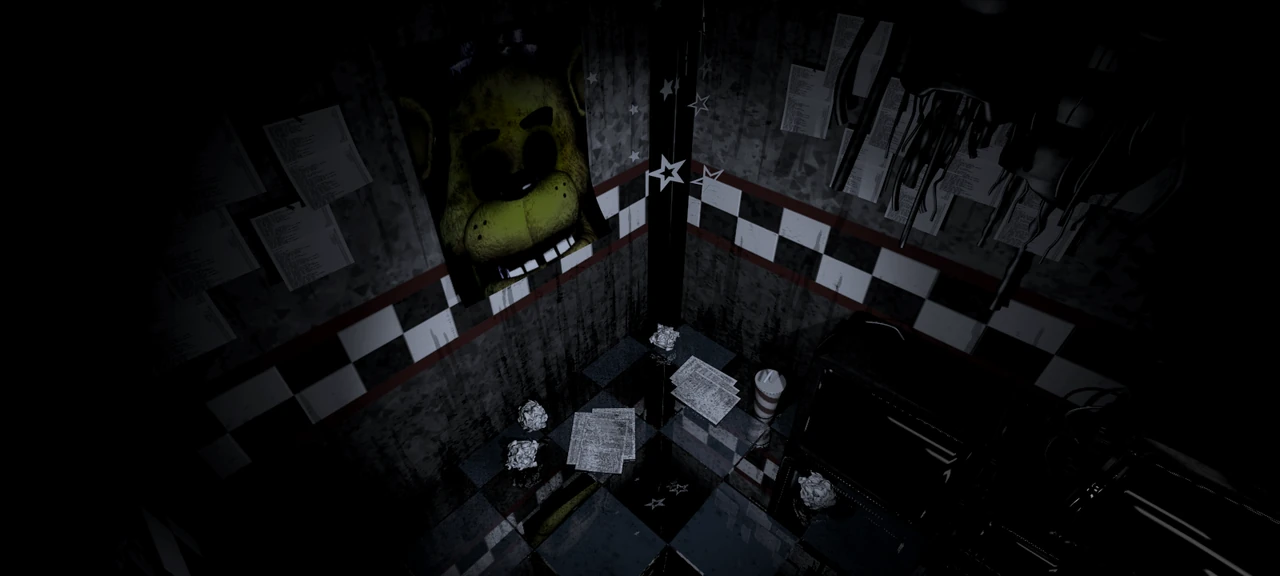
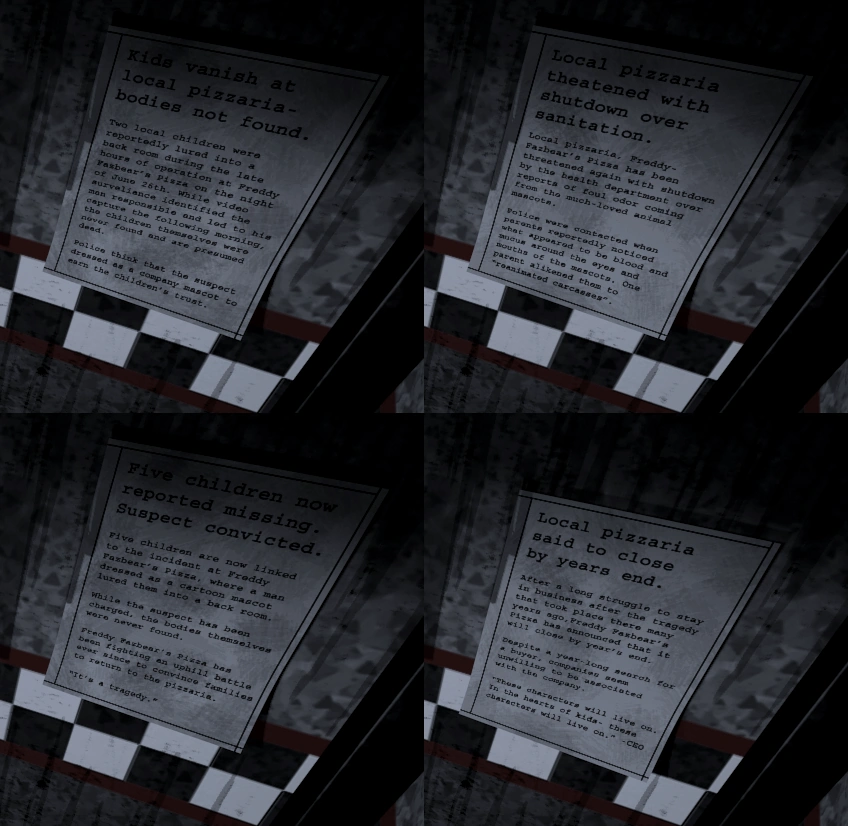
The first game shows a set of newspaper clippings about the restaurant's history. They are tier 1 text, but they reach this wiki through a fan wiki transcription (tier 5) and have not been checked against the game [source 1908].
- "Kids vanish at local pizzaria: bodies not found." The police conclude that the suspect dressed as a mascot to earn the children's trust. Video surveillance identifies him, and he is apprehended on the morning of June 27, after another two murders [source 1908].
- "Five children now reported missing. Suspect convicted." 5 children are missing. The body text says only that the perpetrator was charged, and that with no bodies nothing was proven in a court of law; the fan wiki reads the headline's claim of a conviction as an editorial error inside the fiction [source 1908]. The same article describes the restaurant fighting an uphill battle to bring families back [source 1908].
- Parents and the animatronics. Parents later notice blood and mucus around the characters' eyes and mouths and call the police back to the restaurant; one parent likens them to "reanimated carcasses" [source 1908].
- "Local pizzaria threatened with shutdown over sanitation." The health department threatens closure over foul odour coming from the animatronics, and the wording makes clear it is not the first such threat [source 1908].
- "Local pizzaria said to close by years end." After a year-long search for a buyer fails, a chief executive officer of Fazbear Entertainment is quoted saying the characters will live on in the hearts of children; an unnamed person is quoted calling it a tragedy. Whether this is the same chief executive as the one in Five Nights at Freddy's 2 is not established [source 1908].
See The Missing Children Incident.
Endings
Not read in.
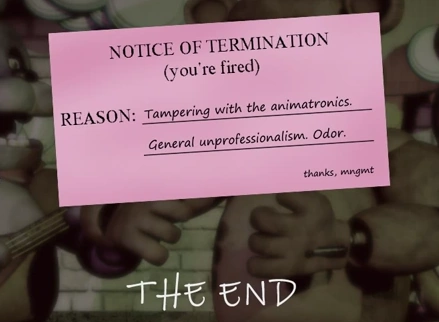
A fan wiki article on the game's cinematics describes 3 endings end screens [source 553]. Completing Night 5 shows Mike Schmidt's paycheck for 120 US dollars with a note from Fazbear Entertainment reading "Good job, sport! (see you next week)". Completing Night 6 shows a second cheque with fifty cents of overtime added and the same note. Completing the Custom Night shows a pink slip instead, terminating him for tampering with the animatronics, general unprofessionalism and odour [source 553].
The game opens on the "Help Wanted" newspaper advertisement Mike answers. The fan wiki records that the filler printed around the advertisement, repeated nine times on the page, is a joke in the creator's voice: it says the advertisement has nothing to do with the game, that the reader will probably not get past Night 3 and most likely will not survive the week, and recommends working as a cashier or in a warehouse instead. The same device is used for the newspaper in Five Nights at Freddy's 2 [source 553].
A fan wiki survey of the endings of every game describes the first game's three, each of them a document handed to the guard [source 843]:
- Night 5. A paycheck made out to Mike Schmidt for 120 US dollars, with a printed message from Fazbear Entertainment reading "Good job, sport! (see you next week)" [source 843].
- Night 6. The same message with a fifty cent overtime bonus added, giving 120.5 US dollars [source 843].
- Custom Night. A pink slip of termination, which gives the grounds as tampering with the animatronics, general unprofessionalism and odour [source 843].
The pink slip is the only one of the three that says anything about the guard himself: see Mike Schmidt and Who is Mike Schmidt?.
Minigames and secrets
The first game has no minigames in the material read so far. Its rooms are reused in the post-night minigames of Five Nights at Freddy's 3: the Show Stage is the starting point for the animatronics in the Night 1, 2 and 3 minigames and for the dead child's soul in the Night 5 minigame [source 2623]. The Kitchen appears there with no door or hallway drawn leading into it, and the Supply Closet is not represented at all; where its entrance should be, in the West Hall, the third game instead places tips for opening its secret minigames [source 1699] [source 2738].
Setting and date
Freddy Fazbear's Pizza. The game never states a year. The only date it prints is on Mike Schmidt's paycheck, which covers the week of 8 to 13 November with no year beside it [source 1269] [source 981].
Two readings circulate on the fan wiki, both inferences rather than statements by the game:
- The early 1990s, often narrowed to 1993. The argument is that the paycheck works out to a minimum wage of roughly 4 to 5 US dollars an hour once tax is allowed for, which fits that period, and that the printed week lines up with the calendar year 1993 [source 981] [source 1269].
- 1995 at the earliest, from the tie-in branching novel Interactive Novel #1: The Week Before, in which Ralph finds a recording left by an earlier Freddy's night guard made almost twelve years before, not long after that guard's daughter was born. The fan wiki notes that the page carrying this cannot be reached without cheating and that it contradicts the rest of the book, so it calls the page's canonicity questionable; it is tier 3 material about a separate telling in any case [source 1269].
The same fan wiki article states that the restaurant was established in 1,983 and ran for roughly a decade until Fazbear Entertainment filed for bankruptcy, which would also put this game's week in the early 1990s; no in-game line is given for the 1983 figure [source 1269]. Phone Guy speaks of the Bite of '87 in the past tense, so the nights fall after 1987 [source 1269].
See When is Five Nights at Freddy's set? and Who is Mike Schmidt?.
Release and ports
Read through a fan wiki article (tier 5) citing store pages, archived listings and interviews [source 981].
Development. Scott Cawthon began the game around February 2014 and spent 6 months on it, by his own account in an Indie Game Magazine interview [source 981]. He submitted it to Steam Greenlight on 2014-06-13, put a trailer on YouTube on 2014-06-14, and launched a Kickstarter the same day seeking 10,000 US dollars, which he cancelled on 2014-06-17; the Kickstarter page shows that the bear was to be called "Freddybear" [source 981]. The fan wiki repeats the widely told account that the game grew out of criticism of his earlier Chipper & Sons Lumber Co., whose characters players said moved like animatronics, and notes that his first gameplay video shows a more pixelated build with a figure and the number 1 beside it on the title screen, which it reads as a scrapped lives system [source 981].
Release. A demo went up on Amazon on 2014-07-23 and on IndieDB the next day. The full game released on 2014-08-08 for Windows, exclusively on Desura at first, with Amazon following; it was greenlit on 2014-08-13 and released on Steam on 2014-08-18 [source 981]. Ports followed to Android on 2014-08-24, Amazon Fire OS on 2014-08-26, iOS on 2014-09-11 and Windows Phone on 2014-12-02 [source 981]. The listed prices are 4.99 US dollars on Windows, 2.99 US dollars on mobile and 7.99 US dollars on consoles [source 981]. The Desura release disappeared with the bankruptcy of Desura's owners [source 981].
Patches that matter to the story. Version 1.13, on 2014-08-17, added the 1/9/8/7 Custom Night easter egg described under Hidden content. Version 1.131, on 2014-12-02, corrected the intro newspaper, which had spelled "pizzeria" as "pizzaria" at launch [source 981]. The Halloween update of 2015-10-27 added seasonal decor [source 981].
The Clickteam remasters. Cawthon announced HD ports with Clickteam in April 2018 [source 981]. The remastered mobile builds released on 2019-07-30 for iOS and in mid-August 2019 for Android (the fan wiki's body text gives 2019-08-16 and its infobox 2019-08-19), and console ports on 2019-11-28 for Xbox and 2019-11-29 for PlayStation and Nintendo Switch [source 981]. These builds fixed bugs, removed copyrighted material and added subtitles and cheats menus; on them Golden Freddy's jumpscare no longer shuts the game down but returns the player to the main menu [source 981]. On the removed material see Scott Cawthon and Five Nights at Freddy's: Help Wanted. The game was rated Steam Deck "Verified" on 2022-02-11 and Steam Machine "Verified" on 2026-07-10 [source 981]. Compilations followed: an Xbox bundle, Five Nights at Freddy's: Original Series, on 2020-10-28, and Maximum Games' Core Collection on 2021-01-12 [source 981].
Reception. The fan wiki records a Metascore of 78 out of 100 for the PC version and the same figure on OpenCritic, with reviewers praising the restraint of the design and the sound and criticising the repetition once the pattern is learned; several compared the setting to Chuck E. Cheese's and the animatronics' move-when-unobserved behaviour to Doctor Who's Weeping Angels [source 981]. IGN placed the game tenth in its "The 25 Best Horror Games Ever Made" on 2024-10-23 [source 981].
Characters
- Freddy Fazbear starts on the Show Stage and cannot leave it until Bonnie and Chica have both gone, even with his AI set to 20 while theirs are at 0 in Custom Night; he does not leave at all before Night 3 [source 2623]. From Night 3 he can enter the Kitchen, where his presence is signalled by his jingle, the Toreador March, though the fan wiki notes the jingle does not always play when he is there [source 1699]. Once Bonnie and Chica have left, he can rarely be seen staring into the Show Stage camera [source 2623].
- Bonnie is usually the first to leave the stage on the earlier nights and approaches through the West Hall; he is the only animatronic who appears in the Supply Closet and in the Backstage, and has a single pose in the closet [source 2623] [source 2738].
- Chica often passes through the Kitchen on any night; the clatter of pots and pans there can be heard whether or not the camera is on it [source 1699].
- Foxy occupies Pirate Cove. Phone Guy advises checking its curtain, saying the character inside becomes more active the longer the cameras are left off [source 2308]. Foxy's fixed route does not pass through the Kitchen [source 1699].
See Characters.
The Office. The room the player never leaves is also the only room Golden Freddy enters; Freddy, Bonnie, Chica and Foxy kill by coming into it, and Mr. Cupcake sits on one of the monitors [source 2829]. The desk carries monitoring equipment with wires running to the ceiling, a fan, a drink, a lamp, balled up papers and a speaker webbed over with cobweb, and the wall behind it holds a poster of Freddy, Bonnie and Chica on stage under the word "CELEBRATE!"; clicking Freddy's nose on it plays a party favour honk [source 2829]. Beside the poster hang children's drawings, the same ones seen in the West Hall (CAM 2A): Bonnie in a present box, Freddy handing a child a present, balloons and a sun, two children around a birthday cake with Freddy's and Bonnie's heads on it, each captioned in large letters that appear to read "MY FUN DAY!!!" [source 2829]. The Office returns in the post-night minigames of Five Nights at Freddy's 3 and as the player's station in the FNAF 1 mode of Five Nights at Freddy's: Help Wanted [source 2829].
The fan wiki's article on the room quotes the Night 1 phone call and attributes it to a speaker it calls "Ralph", without saying where that name comes from [source 2829]. A later source supplies the likely origin: Ralph is the night guard protagonist of the tie-in branching book Interactive Novel #1: The Week Before, who records a message for his replacement at the end of each night [source 1218]. That is tier 3 material about a separate telling, and nothing in the material read so far shows the first game naming its caller, so this wiki does not treat the name as established for the game. A fan wiki article on that protagonist adds that the novel has him record the messages on a mobile phone and identifies two of them as this game's Night 1 and Night 2 calls, and gives "The Phone Guy" as an alias in his infobox [source 2427]. See Who is Phone Guy? and Ralph (The Week Before).
Phone Guy on the past. His Night 1 call says the animatronics used to be allowed to walk around during the day until "The Bite of '87", and remarks on how the human body can live without the frontal lobe; the game never names or identifies the victim [source 1908]. On Night 3 he says most people do not last this long in the job and that he is not implying the previous guards died [source 1908]. See Who is Phone Guy? and The Bite of '83 and the Bite of '87.
Rooms
- Show Stage: the default camera feed, holding Freddy, Bonnie and Chica in front of the Dining Area. The back wall carries round cloud and star decorations and a black and white checkered strip outlined in red. When one animatronic leaves, the two who remain shift position or facing and some background detail disappears; Freddy's jaw closes and his eyes become glossy black with white pupils, and Bonnie's right half becomes invisible. Once an animatronic leaves the stage it does not return until the player dies or the night ends. The Show Stage and the office are the only places where more than one animatronic can be seen at once [source 2623].
- Pirate Cove: Foxy's stage, closed off by a large purple curtain decorated with stars, with a sign in front reading that it is out of order, two lights on the back wall, hanging star decorations and a black and white tiled floor [source 2308].
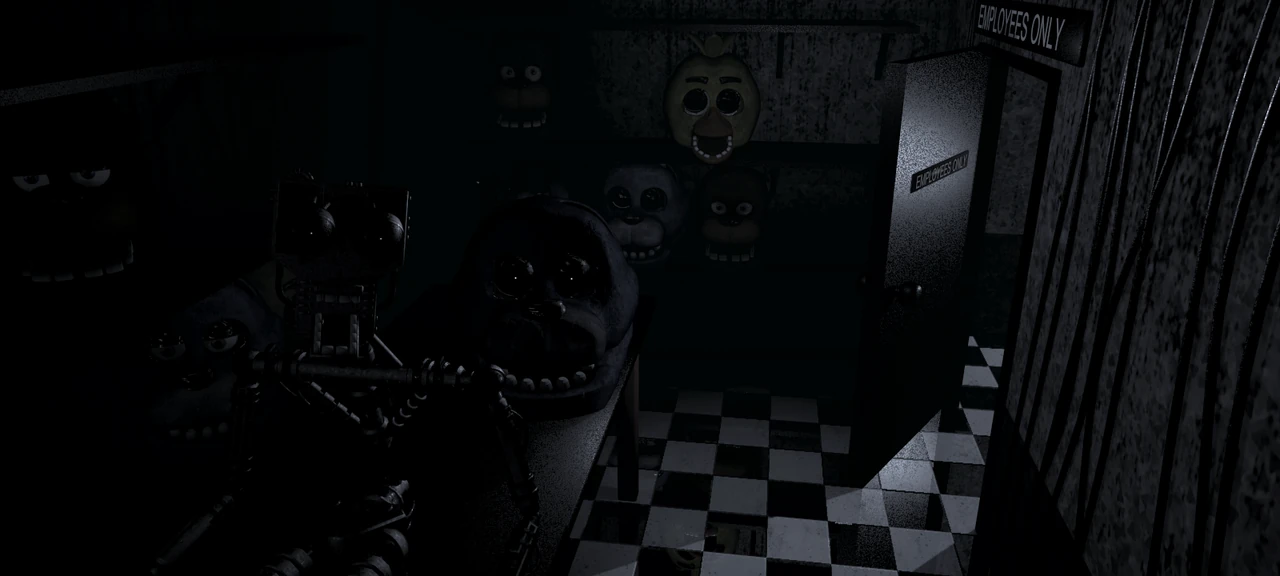
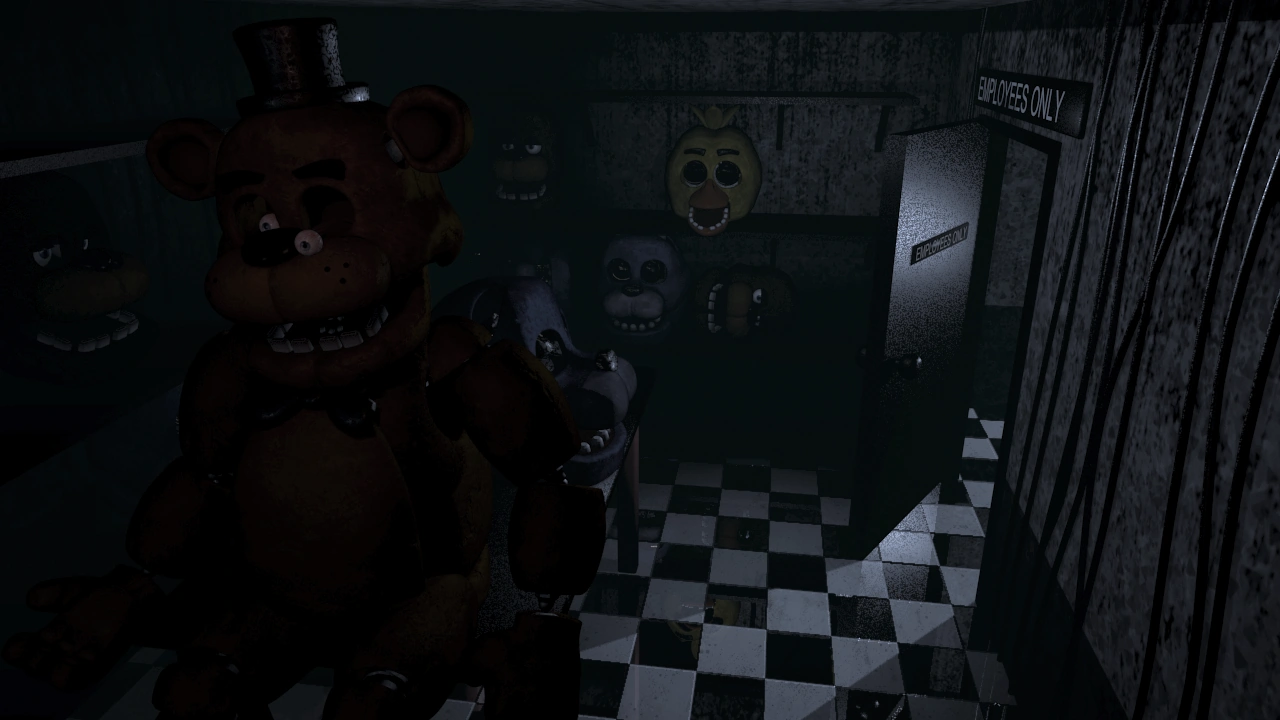
- Backstage (CAM 05): a small room left of the Show Stage where spare animatronic parts are kept against breakages during the day. It has a white and black checkered floor and a table carrying an endoskeleton, Endo-01, and a spare Bonnie head; a shelf at the back holds three more Bonnie heads, two Chica heads and three Freddy heads. An open door on the right wall is signed "EMPLOYEES ONLY", and wires hang loose from the ceiling. Bonnie is the only animatronic who enters it [source 235].
- Kitchen: connected to the Dining Area and the only room whose camera is disabled for the whole game, showing the words "camera disabled" and "audio only" over static. Only Freddy and Chica enter it, and unlike other feeds both can be present at the same time [source 1699].
- Supply Closet: a small room off the West Hall with a shelf of labelled bottles, a broom, a mop in a bucket and a ceiling light. Its camera is the only one mounted on a ceiling, the only one that does not pan, and the only one with just two possible views, Bonnie standing there or the room empty. Its tiles are blue while the West Hall's are red [source 2738].
The Backstage returns in the minigames of Five Nights at Freddy's 3 and as a viewable camera in the FNAF 1 mode of Five Nights at Freddy's: Help Wanted [source 235].
Later reuse
Five Nights at Freddy's: Help Wanted's FNAF 1 Mode recreates these rooms as one of eleven camera areas, with the Kitchen again disabled and audio only and Pirate Cove viewable [source 1699] [source 2308]. Ultimate Custom Night keeps the Kitchen unseen as well, dropping the "camera disabled" text and moving "audio only" to the top left corner [source 1699].
Hidden content
- Beta monitor images show the Supply Closet camera originally placed in the bottom right corner of the room facing the back wall rather than in the top left [source 2738]. This is a tier 4 claim passed on at tier 5 and has not been checked against the game files here.
- The game's trailer shows Freddy, Bonnie and Chica all facing the camera at once, which happens only rarely in the released game, and shows stage walls that differ from the final room, including a jukebox behind Chica that the game does not have [source 2623].
- On Android, a cheat mode can reveal which animatronic is in the otherwise unviewable Kitchen [source 1699].
The Halloween update. A seasonal update added to the first four games on 2015-10-27, available on PC and the remastered mobile ports but not on consoles [source 1462]. In the first game it decorates the Office with Halloween lights and a jack-o-lantern when the date is 31 October, with no effect on play; the mobile port also shows the lights in the dark and the pumpkin when the power runs out [source 1462]. The fan wiki notes that the pumpkin is the one that accompanies Jack-O-Chica, slightly re-textured and given bulbs for eyes, and cites Five Nights at Freddy's: The Freddy Files (Updated Edition, page 16) and Five Nights at Freddy's: The Ultimate Guide (page 9) for the fact that setting a device's clock to 31 October brings the decorations up at any time of year [source 1462]. Read through a fan wiki article (tier 5) describing the game (tier 1) and quoting the guidebooks (tier 3).
The two office corridors
Fan wiki articles on CAM 2 (the West Hall) and CAM 4 (the East Hall) set out what the game hides in the halls themselves (tier 5 describing tier 1) [source 3065] [source 781].
The West Hall corner poster and Golden Freddy. The poster on the wall of the CAM 2B corner can be one of 3 variants pictures: a body shot of Freddy, a distorted picture of Freddy ripping off his own head, or a headshot of Golden Freddy [source 3065]. If the Golden Freddy picture is up, lowering the monitor makes Golden Freddy appear in the office with flickering "IT'S ME" hallucinations and a distorted audio file, and if the player does not raise the monitor again within a second or two his kill screen runs and intentionally shuts the game down; the fan wiki says this usually happens on Night 1 and Night 3 [source 3065]. The article also notes that in the head-ripping variant Freddy's right hand still holds his microphone while the handprint side of his face is untouched, and that the distorted picture is printed on a larger sheet pinned to the wall while the default poster has no pins [source 3065].
The children's drawings. The drawings hung along the West Hall do not look like children's work to the fan wiki, which singles out one it reads as Springtrap with black eyes and white pinprick pupils emerging from a gift box, and another of Freddy in the same manner, and notes that none of the drawn animatronics have their normal eyes [source 3065]. Read against Five Nights at Freddy's 3 and Is Springtrap William Afton? this is a tier 5 identification of a drawing, not a statement by the game.
The East Hall posters. The three cheerful character posters in CAM 4A (Chica with "EATING TIME!", Freddy with "FUN TIME!", Bonnie with "PARTY TIME!") can be replaced, when no animatronic is there, by crude drawings of crying children's faces or by graffiti reading "IT'S ME."; the fan wiki says the crying faces resemble the children's sprites in the death minigames of Five Nights at Freddy's 2 and that it is unknown what triggers the change [source 781].
The rules poster and the clippings. The East Hall corner holds a "Rules For Safety" poster whose 8 rules are transcribed as: don't run, don't yell, don't scream, don't poop on floor, stay close to Mom, don't touch Freddy, don't hit, leave before dark [source 781]. The poster sometimes changes to the newspaper clippings about the Missing Children Incident, which puts the backstory inside the night rather than only on the Game Over screen [source 781]. The fan wiki records two typographical errors in those clippings: "surveillance" misspelled "surveliance" in the article about two children vanishing, and a missing space after "ago" in the article about the restaurant closing [source 781].
Routes and tells. Only Bonnie and Foxy use the West Hall, and Freddy takes it when the power runs out although he is never seen there on camera; Chica, and Freddy once he is active, use the East Hall [source 3065] [source 781]. Viewing Foxy's camera triggers his sprint, and when he runs the end-of-hall light stops flickering and turns white; if Bonnie is in the hall at the same time only Foxy is shown [source 3065]. Watching Freddy on the East Hall corner camera freezes him, and switching away lets him into the office, as does having the monitor down [source 781]. From Night 4 and on Custom Night, Bonnie and Chica twitch and snap their heads in the corners with a sound byte also used by the hallucinations, which is audible with the monitor down and lets the player skip checking those cameras; the sound file is absent from the mobile version, so there the corners must be checked [source 3065] [source 781].
Two production notes from the fan wiki. It says CAM 4A was called the Backstage in Scott Cawthon's beta gameplay footage, which it does not date [source 781], and that CAM 05 and CAM 09 of Five Nights at Freddy's 3 closely reuse the East and West Hall layouts, down to the door on the left wall and a cartoon drawing in a comparable position, with Springtrap standing roughly where Chica and Bonnie stand here [source 781] [source 3065].
The garbled speech under the Night 5 call. A fan wiki article on the fan game series The Joy of Creation states that the distorted speech in this game's Night 5 phone call is a heavily distorted, reversed reading of a passage from Paramhansa Yogananda's Autobiography of a Yogi, with words and syllables left out, and that the phrase at the end, which the community long heard as "the joy of creation" and which gave that fan game its name, is really "the joy of creative service" with the last words cut off, leaving "the joy of crea" [source 2800]. This is a community decoding of audio the game plays (tier 5 reading tier 1) and has not been checked against the game here. See The Joy of Creation.
Easter eggs and their odds
A fan wiki catalogue of the first game's random easter eggs (tier 5 describing tier 1) gives the following, most of which can fire on any night, including Night 1 [source 787].
- The "CELEBRATE!" poster honk. Clicking Freddy's nose on the office poster plays a party favour honk. The fan wiki calls this the start of a series tradition, kept in every later game except Freddy in Space 2, Fury's Rage and Chica in Space [source 787].
- Visual hallucinations, 1 in 1,000 each second: the words "IT'S ME" flash over rapidly alternating images of a black-eyed Bonnie whose left pupil is off centre and of Freddy with human eyes, with visible blood vessels. They can fire while the monitor is up or after the power is gone, and are guaranteed when Golden Freddy appears in the office [source 787]. The accompanying audio is the sound Bonnie and Chica make in the hall corners on Night 4 and later, which produces a bug: triggered on Nights 1 to 3 while one of them is in a corner, the clip keeps playing until they leave [source 787]. The fan wiki reports a community belief that the clip is a distorted recording of someone reading from Paramahansa Yogananda's Autobiography of a Yogi; that is a tier 5 identification, not a statement by the game [source 787].
- Show Stage Freddy stare, 1 in 10 when the monitor is raised, if Freddy is alone there: he faces the camera with black eyes and white pinprick pupils [source 787].
- Pirate Cove graffiti, 1 in 10 when the monitor is raised, if Foxy has left: the "Out of Order" sign is replaced by "IT'S ME" [source 787].
- West Hall corner posters, only while Bonnie is not in the room: 1 in 100 for the picture of Freddy tearing off his own head, and 1 in 32,768 each second for the Golden Freddy close-up, which is followed by a child's laugh and by Golden Freddy appearing in the office when the monitor is lowered, once per night [source 787]. The Golden Freddy poster was meant to be 1 in 100,000; the fan wiki cites ItzTaken's video "How everyone got Golden Freddy's odds wrong" for the finding that the game's random number generation overflows at 65,535 under 16-bit integers, leaving the real figure at 1 in 32,768 [source 787]. That is tier 4 code analysis reported at tier 5.
- East Hall posters, only while Freddy and Chica are off that camera: 1 in 100 for crudely drawn screaming and crying children, which the fan wiki compares to Munch's The Scream, and the same chance for the posters to be replaced by "IT'S ME" graffiti. These appear together with the third and fourth newspaper variants respectively [source 787].
- East Hall corner newspapers, 1 in 25 when the monitor is raised: the "Rules for Safety" poster is replaced by one of the four clippings about the Missing Children Incident transcribed above [source 787].
- Backstage, 1 in 20 for Endo-01 and the spare heads to turn and stare into the camera while Bonnie is absent, and 1 in 10 for Bonnie himself to stare into it while he is there [source 787].
- Office metal door pounding, 1 in 50 every ten seconds, at varying volume, audible even with the monitor up. The fan wiki states that Scott Cawthon acknowledged this easter egg in one of Dawko's livestreams and has refused to say what the sound is meant to be; the article gives no date for the livestream, so this is an undated tier 2 remark reaching us at tier 5 [source 787].
- Circus organ, 1 in 30 every five seconds, and Foxy's song, 1 in 30 every four seconds, the latter only while Foxy is not advancing, so it doubles as a safety signal [source 787].
- Post-mortem Golden Freddy, 1 in 10,000: his jumpscare loads instead of the title screen after a Game Over [source 787].
- Eyeless Bonnie screen, 1 in 1,000 on any return to the title screen: a still of Bonnie with empty sockets, which after 9.5 seconds gains two small white pupils for half a second [source 787].
- 1/9/8/7. From version 1.13, setting the Custom Night AI levels to 1/9/8/7 and pressing Ready loads Golden Freddy's jumpscare. The fan wiki states that Cawthon added it to stop a false rumour that the code unlocked an alternate ending about the Bite of '87, so the easter egg is a reply to the community rather than a clue [source 787] [source 981]. See The Bite of '83 and the Bite of '87.
The hallucinations, the door pounding, Foxy's tune, the circus organ and Chica's noise in the Kitchen can all play during a power outage [source 787]. The fan wiki also repeats the claim that the black-eyed Bonnie images reflect Cawthon's own view that Bonnie is the scariest of the four, and that he had nightmares about him during development; it gives no source or date for the statement, so it is recorded here only as a community claim [source 787].
The Pirate Cove sign and the singing. The sign on Pirate Cove normally reads "-Sorry!- Out of Order", but when Foxy the Pirate has left his curtain it sometimes reads "IT'S ME" instead, with the stars on it shifted to one side [source 2312]. The singing heard at random points during a night also comes from the cove and grows louder while that camera is viewed [source 2312]. In Five Nights at Freddy's: Help Wanted the "IT'S ME" sign is no longer random and appears every time Foxy leaves [source 2312].
The Night 5 phone call. A fan wiki account of Night 5 says that in place of the recorded voice of Nights 1 to 4 the player hears deep, distorted voices, and that the call ends in static and an animatronic screech which cuts off about a quarter of the way through, three times over [source 2073]. The same article says that when the garbled speech is decoded it is a passage beginning "application of electric currents or heavy pressure" and breaking off at "to indicate", and that the garbled noise some of the animatronics make is the same passage shifted a few lines [source 2073]. It adds that these distorted voices are the same sounds used when Bonnie's and Chica's heads twitch in the East and West Hall corners and during Golden Freddy's visual hallucinations, distorted further [source 2073]. The article does not name the work the passage comes from, and the decoding is community work on the game's audio (tier 5 on tier 1), not something the game states. See Phone Guy (Ralph) for the voice heard on the other nights.
The same article records that a long-held belief about this night, that Freddy plays a shorter jingle and attacks faster when the power runs out on Night 5, has been disproved in videos by Tech Rules and Markiplier [source 2073].
Version history and changed text
A fan wiki update log (tier 5 reporting patch notes) records what changed in the game after release; several of the changes alter text or content the game shows [source 1075].
- 1.10, 2014-08-13. The night skip code was changed from "CD0" to "CD+"; the Continue button was made to read "Night 1" rather than "Night 0"; the typo "pizzaria" in the opening newspaper was corrected and the clipping tilted further; the game border became black; windowed mode was added; and a bug was fixed by which Bonnie and Chica standing in their blind spots at the same time left both harmless [source 1075].
- 1.13, 2014-08-17. A warning screen was added; setting the Custom Night difficulties to 1/9/8/7 was made to play Golden Freddy's jumpscare at once; beating 20/20/20/20 was made to award a third and final star on the title screen, which the fan wiki illustrates with a post by Scott Cawthon confirming it; and the "Extreme" difficulty label changed from "12+" to "13-20" [source 1075]. The code is the year of Five Nights at Freddy's 2 and of the bite recorded in The Bite of '83 and the Bite of '87; the log gives no reason for the choice.
- 1.131, 2014-12-02 (Steam). The opening newspaper was zoomed in and tilted and the phone number printed on it changed from "1-888-FAZ-FAZBEAR" to 1-555-FAZ-FAZBEAR; the Android build received the same change as version 1.85 on the same day [source 1075].
- 1.132, 2015-10-27 (Halloween Update). A jack o'lantern on the desk and decorative lights in the office appear when the computer's date is set to 10/31; night lengths and other intervals were corrected after an engine glitch [source 1075].
- Mobile, August to September 2014. A run of rapid patches changed Bonnie and Chica's jumpscare frames, Freddy's pacing through the power-out stages, the animatronics' movement intervals and the rate of power drain, and added a shop with desk plushies and a paid cheat mode that was removed, reinstated and moved more than once [source 1075].
- Clickteam's remaster. Version 2.0 reached iOS on 2019-07-30 and Android on 2019-08-16 with higher resolution art and the cheat pack renamed the Survival Kit; later updates added an options screen (2020), subtitles in 11 languages and a Foxy desk plushie (December 2021), and removed the short delay on flipping the monitor (2023-10-04) [source 1075]. Console builds were patched on 2022-03-11 with revamped options and pause screens and subtitle options [source 1075].
These are production changes rather than story, but the newspaper, the Continue label and the Custom Night code are all text the game shows, so the version a claim is taken from matters.
Music
A fan wiki soundtrack list identifies almost all of the first game's audio as stock library music, with one original cue written later for the ports (tier 5 describing the game's files) [source 2657].
- Menu. The original Steam release uses "Urban Darkness Part 08", a stock track by Bjørn Lynne. Clickteam's later ports replace it with a cover by Leon Riskin, which the fan wiki calls the only original piece of music in those versions [source 2657].
- Freddy's leitmotif. The jingle Freddy plays when the power runs out, when he is in the Kitchen, and over the Night 5, 6 and 7 completions is "Les Toréadors" from Georges Bizet's Carmen, taken from a Sound Ideas "1905 Regina Music Box" sample [source 2657]. The fan wiki notes it is also briefly heard in Ralph's fourth phone call in the tie-in The Week Before [source 2657].
- Circus organ. The carousel music that occasionally plays during the night is the Sound Ideas cue "1810 Circus Pipe Organ 02" [source 2657].
- Ambience. The main night ambience is a slowed version of "Cold Presence" by Erik Haddad, the track used in the game's first trailer. A second stock ambience rises with the number of threats in the two halls and the supply closet: the fan wiki gives 30 percent volume for one, 50 for two, 75 for three, and 100 percent when Freddy is in the Office. A third, used when the power is out, is reused in Ultimate Custom Night [source 2657].
- Trailer. A track called "BOPSHOR", by BeachWare, is faintly audible under "Cold Presence" and the children's voices during the trailer's stage scene [source 2657].
- Port trailers. The fan wiki states that "Evil Power", credited to Alex Khaskin and used in Clickteam's port trailers, is a mashup of two Tyler Bates tracks written for Killzone Shadow Fall [source 2657]. That is an allegation about a library composer which this wiki cannot check; it is recorded here as the fan wiki's claim, not as fact.
Statements by Scott
None read in. A fan wiki calls the Supply Closet's blue tiling, against the red of the hall it opens onto, most likely an oversight by Scott Cawthon; that is the fan wiki's guess and not a statement by him [source 2738].
From the archived interviews (tier 2, via a tier 5 digest). A fan wiki page collecting Scott Cawthon's five interviews, the latest Dawko's of 2024-08-04, records the following; the digest does not say which interview each answer came from [source 2563].
- The game took about 6 months to finish, which puts the start around February 2014 [source 2563].
- He did not plan sequels, but knew the story in this game was a snippet of a larger story [source 2563].
- Freddy was the first character he made and was always going to be the lead: a bear in a top hat with a microphone, unplanned beyond that. Bonnie and Chica came as naturally; the fourth character took longer, with a fox, a wolf and a beaver in the running. The beaver led for a while before he judged it too close to Chipper from his 2013 game Chipper & Sons Lumber Co. [source 2563].
- The mechanics were not based on his 2014 game Sit 'N Survive, despite the common claim. He wanted something simple and short that would not take years, which is where the stationary survival design came from [source 2563].
- The kitchen camera was disabled on purpose, as an attempt to make audio matter more; the power meter exists to force players to leave doors open despite the danger; and Freddy's attack after a blackout is an example of the false sense of security he used as a fear tactic [source 2563].
- He priced it at 4.99 US dollars because he saw it as a short game and wanted it accessible and fair, and made it playable without English so anyone could play [source 2563].
- Phone Guy's lines, which he refers to as Ralph's lines, are the only notes he took during development. Characters took one to two days each to model, and he always worked with final graphics to avoid losing motivation [source 2563]. See Who is Phone Guy?.
- He would not change or add anything to the game, and would not go back to 2014 to change anything at all; his favourite memory is the first jumpscare, and Bonnie was the one that got him and his children [source 2563].
- His son Ian suggested that clicking Freddy's nose should honk [source 2563].
- A later caution on the game as played today: in the remastered console ports Golden Freddy no longer crashes the game but returns the player to the menu [source 614]. See The remastered console ports.
2018, fourth anniversary interview: the beaver that was going to be the villain. Cawthon said that a beaver animatronic was originally intended as the game's main antagonist in place of Freddy Fazbear, and in a second version as a performer with his own stage separate from the band, and that he scrapped both because the character was too obviously Mr. Chipper from his earlier game Chipper & Sons Lumber Co.; the stage act became Foxy instead [source 809]. This reaches the wiki through a fan wiki trivia page citing the interview video (tier 2 through tier 5), which also suggests the design was later reused for El Chip [source 809]. It says nothing about the story: it is an account of how the first game's cast was settled.
Theories
- The Kitchen's permanently dead camera is the game's one deliberately blind room, forcing the player to track Freddy and Chica by sound alone. Nothing in the material read so far offers an in-universe reason for the camera being disabled [source 1699].
- Freddy's dependence on the other two, including in Custom Night where his AI cannot override it, is a hard rule of the first game's movement and is repeated in Five Nights at Freddy's 2, where neither Freddy nor Toy Freddy leaves until the animatronics beside them have [source 2623] [source 2624].
See Games and Master timeline.
Releases and demos
A demo was released on Amazon on 2014-07-23 and on IndieDB the following day, with an Android demo in August 2014 that was removed after Clickteam's remastered updates; it played like the full game but offered only Nights 1 and 2 [source 982]. Read in through a fan wiki article (tier 5), which cites archived IndieDB download pages.
Its patch notes are worth keeping because of what they date [source 982]:
- 1.1 (2014-08-13): windowed mode added, the game border changed from white to black, a bug fixed where an animatronic's scream played without an attack, and a typo in the opening newspaper corrected, where "pizzeria" had been spelled "pizzaria" [source 982]. The newspaper clippings transcribed above still carry that spelling in their headlines, so the fix applied to the body text of the opening advertisement rather than to every clipping; the material does not say more.
- 1.12 (2014-08-14): Freddy's AI on Nights 5 and 6 set to 3 and 4 instead of a randomly chosen 2 or 3 and 3 or 4, and the cameras locked during Foxy's and Freddy's jumpscares [source 982].
- 1.13 (2014-08-17): a warning screen and a third star added, the "Extreme" difficulty label changed from "12+" to "13-20", and the Golden Freddy jumpscare added for entering the AI levels 1, 9, 8 and 7 on Custom Night [source 982].
That last item dates the 1/9/8/7 code, and with it Golden Freddy's tie to the year 1987, to within a month of the game's launch. See Golden Freddy and The Bite of '83 and the Bite of '87.
The fan wiki adds that the demo's texture assets remain in the full game's files as leftovers, and that a 1.0 build of the demo was posted to the Internet Archive by a user named Fearagen on 2023-12-12 before being taken down [source 982]. Both are tier 4 claims passed on at tier 5 and unchecked here. A demo is pre-release material: its behaviour is not necessarily the released game's.
Unused and removed content
Gathered from a fan wiki catalogue (tier 5) of the game's files and pre-release material (tier 4), plus one dated statement by Scott Cawthon (tier 2) [source 2997]. Cut content is not canon.
- The stare screen. The frame of Freddy, Bonnie and Chica looking straight into the Show Stage camera appears in the game's trailer but exists only inside the files: the fan wiki says it is absent from the Clickteam Fusion project and was never shown during gameplay in any version, while noting unverified claims that players have seen it [source 2997].
- A lives system. Beta builds had a life meter, visible in Scott Cawthon's own gameplay video, and "lives" text with the project names
tiny liveandtiny mansurvives in the files. Nothing of it reached release [source 2997]. - An earlier monitor. The early camera map used small circles with cones showing each camera's facing, which turned green and grew when selected, and placed some cameras differently: the Backstage camera beside or behind the door, the Kitchen camera on the same wall as its door pointing into the room [source 2997].
- Newspaper revisions. The first demo's newspaper misspelled "pizzeria" as "pizzaria" and carried a different phone number; the typo was fixed in the demo patch and the number changed in the full game's last patch to avoid real calls [source 2997].
- An earlier endoskeleton. The Steam Greenlight art and the trailer show a different endoskeleton head, with triangular metal teeth, metallic red-tinted eyes and rectangular nostrils that the finished game drops [source 2997]. See Endoskeletons.
- East Hall as Backstage. Early gameplay footage labels the East Hall "Backstage", which the fan wiki calls a slip on Scott's part [source 2997].
- Mobile leftovers. The original mobile port opened on Freddy's cover render and used a different hall light click, both removed in Clickteam's remaster [source 2997].
- The fourth character before Foxy. In Dawko's fourth-anniversary interview of 2018-08-08 Scott Cawthon said he first thought of a wolf animatronic for the fourth character, then a beaver, and dropped the beaver for being too close to Mr. Chipper from Chipper and Son's Lumber Co., arriving at Foxy [source 2997] [source 2967]. A fan wiki suggests the wolf idea resurfaced in the novels as Twisted Wolf [source 2967].
Jumpscares and the Game Over screen
Read in through a fan wiki catalogue of the game's deaths (tier 5) describing what the game shows (tier 1) [source 1649]. Most of it is mechanics, but three parts of it are story evidence.
The Game Over screen. Every death but Golden Freddy's ends on a dark still image of the guard's body in the Backstage: a Freddy suit now sits on the table where the spare endoskeleton was, with the guard's eyes and teeth visible inside it [source 1649]. The fan wiki notes that light still comes in from outside even after a power failure, and reads that as the body being found the following day [source 1649]. This is the game's only depiction of what happens to the player, and it matches the first game's phone calls about costumes and stuffing; see Who is Mike Schmidt? and Endoskeletons.
Golden Freddy. On any night, and especially Nights 1 and 3, the poster in the West Hall Corner (CAM 2B) can change from Freddy to a close-up of Golden Freddy; if the player then lowers the monitor without switching cameras, Golden Freddy is sitting in the office. Images of the animatronics and the words "IT'S ME" flash with a distorted robotic voice, and after a few seconds the game closes itself rather than showing the Game Over screen, or resets to the title menu on non-PC consoles [source 1649]. Raising the monitor quickly avoids it. The fan wiki gives three states for that poster (a Freddy body shot, Freddy tearing his head off, and the Golden Freddy headshot), counts a 1 in 10,000 chance that his jumpscare replaces the return to the menu after any ordinary death, and says his image is an edited version of one of Freddy's hallucination screens [source 1649].
The Pirate Cove sign. Checking CAM 1C while Foxy is already on his way rarely shows the sign reading "IT'S ME" in place of "Sorry! Out of Order" [source 1649]. The same phrase recurs across the series; see Who is Cassidy?.
The power failure. When the power runs out the office goes dark, any closed doors open, the interface disappears, Freddy's footsteps are heard in the West Hall, and his lit face flickers in the left doorway while a music box version of the Toreador March plays, for up to 20 seconds; the screen then goes black for a random interval before he attacks [source 1649]. The belief that staying still delays him, which players drew from the phone call's advice to play dead, is false: the fan wiki states that nothing in the game checks for player input and that the interval is randomised [source 1649]. It also notes that Freddy approaches from the left door when the power is out even if he was last on the east side, making him the only animatronic that can attack from both corridors and the only one with two different jumpscares [source 1649].
Mechanics worth recording. Bonnie always arrives at the left door and Chica at the right, and a door or light that stops responding means one of them is already inside and will attack the next time the monitor is used [source 1649]. Foxy cannot be stopped by watching the cameras, only delayed, and each time he bangs on a closed left door he drains [unknown fact formula.fnaf_1.foxy_power_drain], where n counts his attacks including the current one [source 1649]. Freddy can only enter the office when the right door is open, the monitor is up, and the camera is on a room other than CAM 4B [source 1649].
Out of universe. The fan wiki identifies the unedited scream used for the attacks as coming from the film Inseminoid, and Golden Freddy's as the same scream slowed and pitched down [source 1649]. It also records that Bonnie's jumpscare in the original trailer differs from the one in the finished game [source 1649].
Ports and mobile versions
The first game was ported to Android on 2014-08-25 and to iOS on 2014-09-11, both at 2.99 US dollars, with an Amazon Fire OS version at the same price that lacked the in-app purchases; an update on 2019-07-30 rebuilt both ports to match the PC version [source 991]. Read in through a fan wiki article on the mobile port (tier 5) [source 991].
The original mobile build differs from the PC game in ways that matter to anyone reading behaviour out of it [source 991]:
- Time runs faster: roughly 45 seconds an hour and 4 minutes 30 seconds a night, against the PC game's 89 second hours (90 for 12 AM) and 8 minute 55 second nights. Power drains faster and the animatronics are more aggressive to compensate, and in the earliest version Bonnie and Chica moved faster still [source 991].
- **Golden Freddy never appears in the Android version**, which the fan wiki attributes to a bug in Clickteam Fusion 1.85 that stops his random event firing; on other platforms his chance is lower than on PC because the nights are shorter [source 991]. On mobile he could freeze the game outright, and in the remaster his jumpscare returns the player to the main menu instead [source 991].
- Menu and monitor static and some sound effects are degraded or absent; the jumpscares do not shake, simply filling the screen and lasting longer; Freddy's power-out music runs about ten seconds at most before the attack; Freddy does not play his jingle in the Kitchen; an image of Freddy is shown before the main menu; and the office and camera views are stretched [source 991].
The mobile version also adds an in-app shop with no counterpart on PC [source 991]:
- Plushies of Freddy, Bonnie and Chica at 0.99 US dollars each, placed on the office desk as decoration, with a Foxy plush added in the remaster [source 991]. The fan wiki notes the same plushies return in Five Nights at Freddy's 2 as Custom Night rewards and as in-universe Prize Corner prizes [source 991]. See Mr. Cupcake and locations/prize-corner.
- Cheat Mode, also called the Survival Kit, at 4.99 US dollars: unlimited power, fast nights, and a radar map showing each animatronic's position by its head [source 991]. It does not grant invincibility, and Golden Freddy can still attack through closed doors, since he is not located anywhere on the map [source 991]. Clickteam later gave these cheats away free in its console and mobile ports [source 991].
The radar is a window onto the game's movement system rather than evidence about the restaurant, and the port's faster clock makes it a poor source for how often anything happens. Where this wiki cites behaviour from the first game, it means the PC version unless it says otherwise.
Custom Night
The seventh and final playable night, unlocked after Night 6, is a settings screen rather than a scripted night: the player sets an artificial intelligence level between 0 and 20 for Freddy, Bonnie, Chica and Foxy, 21 settings each, and then plays a night with those values [source 2090]. Golden Freddy alone cannot be set [source 2090]. Read in through a fan wiki article (tier 5) that describes what the game does and reports values and timings taken from its files (tier 4) [source 2090].
The nights as settings. The same article gives the Custom Night equivalent of each scripted night, in the order Freddy, Bonnie, Chica, Foxy: Night 1 0-0-0-0, Night 2 0-3-1-1, Night 3 1-0-5-2, Night 4 1-2-4-6 or 2-2-4-6, Night 5 3-5-7-5 and Night 6 4-10-12-6 [source 2090]. The screen's own default when it is first unlocked is 1/3/3/1, which matches no night exactly [source 2090]. There are 194,481 configurations possible combinations in all [source 2090].
How the levels behave, as the fan wiki describes the game's rules [source 2090]:
- Freddy never leaves the Show Stage until both Bonnie and Chica have left it, so Freddy at 20 with Bonnie and Chica at 0 stays onstage until the later hours.
- Whatever his setting, Freddy comes for the player when the power runs out; the only escape is the clock reaching 6 AM before his jingle ends, and the length of that jingle is random rather than affected by how still the player keeps.
- Level 0 does not switch the others off. Bonnie's level rises by 1 at 2 AM, 3 AM and 4 AM, and Chica's and Foxy's at 3 AM and 4 AM, so 0/0/0/0 still plays roughly like Night 1 and Foxy can still, rarely, attack. Freddy's level alone stays fixed all night.
- The routes are fixed by character: Bonnie works down the west side through Backstage, the Dining Area, the West Hall and the Supply Closet and can skip a camera; Chica works down the east side through the Dining Area, the Restrooms, the Kitchen and the East Hall and cannot skip; Freddy follows one fixed order to the East Hall Corner and then waits there until the monitor is raised on some other camera. Foxy does not travel at all but advances through four stages in Pirate Cove, and cannot move while the monitor is up except once he has reached the fourth stage.
- The checks are on a tick timer, a tick being about a hundredth of a second: the game rolls a number from 1 to 20 against the set level every 302 ticks for Freddy, 497 for Bonnie, 498 for Chica and 501 for Foxy [source 2090]. This is file-level detail reaching the wiki through a fan wiki article.
20/20/20/20. Setting all four to 20, called "4/20 mode" by the community, awards the third and final star on the main menu [source 2090]. The fan wiki records that Scott Cawthon hinted repeatedly that the mode was close to impossible and that there was no reward for it until he learned otherwise: on 2014-08-21 the streamer BigBugz and the YouTuber Markiplier were the first confirmed to finish it, and Scott commented on BigBugz's video that this completion is why he added the third star [source 2090]. That is a statement by Scott reported at tier 5, undated beyond the video it was left on.
1/9/8/7. Entering that code, a reference to the Bite of '87, does not start a night: as of version 1.13 it instantly plays Golden Freddy's kill screen and closes the game [source 2090]. The fan wiki says Scott added this to put down the rumour that the code led to an alternate ending [source 2090]. Two further rumours are reported as false: that 0/6/6/6 or 6/6/6/6 would enable the Kitchen camera, which the wiki rejects on the ground that the game holds no image files for the Kitchen at all, and that 2/0/1/5 would unlock something to do with Five Nights at Freddy's 2, which was released in 2014 [source 2090].
The termination notice. Finishing the Custom Night gives the player a pink Notice of Termination: fired for tampering with the animatronics, general unprofessionalism and odor [source 2090]. The fan wiki notes that the guard is fired for tampering even if the default settings are never touched [source 2090]. See Who is Mike Schmidt?.
One detail of the settings screen itself: Foxy's portrait on it shows him already damaged, which the fan wiki treats as most likely a reuse of the existing model rather than a statement about when the photograph was taken [source 2090].
Credits
From the game's credits, as a fan wiki lists them (tier 5 reporting tier 1) [source 1073]:
- Scottgames, LLC as lead developer, with Clickteam LLC credited as porting developer [source 1073].
- Scott Cawthon as the voice of Phone Guy, that is Scott Cawthon himself [source 1073].
- Music: Bjørn Lynne for the original stock title track and Erik Haddad for the original stock ambient music, both credited as stock rather than commissioned pieces, and Leon Riskin for the remastered title track used in the later releases [source 1073]. See Leon Riskin and The remastered console ports. Haddad's stock track "Cold Presence" was also the music of the first game's trailer and was reused for the FNaF World trailer [source 2670].
- Stock audio from Sound Ideas, SoundDogs and Hot Ideas Inc., with the jumpscare scream performed by Judy Geeson [source 1073].
- Beta testing by Ian Cawthon, Braden Cawthon and two unnamed friends of Scott's [source 1073].